A Third of Us

By Marvin J. Newell (summary by Jeffrey Bush)

  • Unreached means they have no access to the gospel.
  • The three “no’s” of the unreached:
  1. No Bible
  2. No church
  3. No known believers
  • it could also be said as
  1. No believers
  2. No Bible
  3. No body of Christ.
  • According to Joshua Project, there are 17,468 people groups in the world. Of these,
    7,419 (41%) are unreached.
  • We have people around us that are unsaved, but we cannot classify them as
    unreached. People in America have some form of access to the gospel, whether they
    have believed or not. They may remain unrepentant, but they are not unreached.
  • The five different times that Jesus gave the great commission were sequential, but
    not synoptic. It was not the same account spoken about five times, they are five
    different occasions that Jesus said these words. He is stressing the importance of
    taking the gospel by repeating it over and over.
  • God is a missionary God. What does it mean to be sent on mission? The word
    mission has four components:
  1. As sender
  2. A person sent
  3. Those to whom one is sent
  4. An assignment
  • Have you thought about what Jesus did not say in the great commission? He did not
    tell them where they were to go, how far they were go, how long they were to go,
    why they were to go, nor the specifics of the message, rather He was informing them
    that they were being sent.
  • People believe the message because they believe the messenger. Make Christ your
    evident passion that others can detect in your life.

Winning Your Wife Back

By Gary Smalley (summary by Jeffrey Bush)

  • Identify things that can damage your game plan of progress.
  • When your wife is offended, her spirit, soul, and body closes up. Although there are
    many ways to offend your wife, here are some principal ways: speaking harsh words,
    telling her that her opinion doesn’t matter, making jokes at her expense, taking her
    for granted, not appreciating her, not trusting her, being rude to her in front of others,
    and dismissing her needs.
  • A man does many things to close his wife’s spirit, but the key is to find ways to open
    it back up.
  • Here are attitudes that can drain a damaged spirit:
  1. Become soft and tender towards your wife. You didn’t get to where you are
    quickly, so you need to be willing to spend the time to be soft and tender.
  2. Understand as much as possible, what your wife has went through. Listening
    communicates to your wife that you care for her.
  3. Acknowledge that your wife is hurting, and then admit your mistake and seek
    forgiveness. Seeking forgiveness opens your wife’s heart back up towards
    you.
  4. Show genuine repentance. As a matter of the heart, mind, and behavior.
  • Listen to understand, and listen with your heart.
  • A good listener is patient, doesn’t do something else at the same time, is focused on
    the person, makes eye contact, and does not grunt responses.
  • Listening takes time, and that’s why so few are good at it. Your wife wants to know
    that she has been heard.
  • Solutions seem to come when both take the time to understand each other.
  • A genuine attitude is key when seeking forgiveness.
  • Having a humble spirit is probably the best way to melt your wife’s angry and closed
    spirit. Humility improves a situation by leaps of bounds.
  • Honoring your wife puts feet to the words “I love you.”
  • Learn to have sacrificial love. To sacrifice is to give up, and that’s what you must do
    for your wife – let her choose in almost every area.
  • Trust is a cornerstone to marriage. If trust has been broken, ask your wife for a list of
    things you can do to win her trust back. If she will not give you an answer, ask some
    of her friends to give you a list.
  • Don’t make it your goal to just get your wife’s trust back, make it your goal to be the
    man God wants you to be, and the man your wife needs.
  • Join an accountability group to help you be and to continue being the man you
    should be.
  • A woman has four basic needs that help her feel deeply loved:
  1. Unconditional security—making plans, cultivating a spirit of truthfulness, etc.
  2. Meaningful words – this is like water to a dry soul. No marriage can survive
    without communication. Your relationship will be as good as your
    communication.
  3. Emotional, romantic bonding. Romance does not just happen.
  4. Positive, physical touching. Nonsexual touching is extremely important for
    your wife. Hugging, patting, massaging, and touching in nonsexual ways.

The Laws of Lifetime Growth

By Dan Sullivan (summary by Jeffrey Bush)

  1. Always make your future bigger than your past. Allow what you know to
    push you to bigger achievements.
  2. Always make your learning greater than your experience. Experience does
    not mean growth. You don’t get to choose all of your experiences, but you
    can choose to learn from them.
  3. Always make your contribution bigger than your reward. It’s the
    contributions that make us grow, not the rewards.
  4. Always make your performance bigger than your applause. Applause can
    be intoxicating, causing you to build your life around what others think. The
    best performers are those that seek to improve and grow. Applause should
    be a byproduct, but never the goal itself.
  5. Always make your gratitude greater than your success.
  6. Always make your enjoyment greater than your effort.
  7. Always make your cooperation greater than your status.
  8. Always make your confidence greater than your comfort.
  9. Always make your purpose greater than your money.
  10. Always make your questions bigger than your answers.

The Freedom of Self-Forgetfulness

By Timothy Keller (summary by Jeffrey Bush)

  • The ego often hurts because it is drawing attention to itself.
  • We say our feelings are hurt, but our feelings cannot be hurt, it is our ego that is hurt.
  • Your identity and self-worth is not in what others think of you but rather what the
    Lord says about you.
  • In 1 Timothy 1:15, Paul said he was chief amongst sinners. Not that he used to be,
    but that he was. We are not used to someone with such confidence, as Paul, saying
    they are unworthy. His ego was not drawing attention to himself, he is not paying
    attention to himself anymore.
  • Gospel humility is not thinking more of yourself, or less of yourself, it is thinking of
    yourself less.
  • A true gospel person is not a self loving person or a self hating person, rather a
    gospel humble person. And a true gospel humble person is a self forgetting person.

The Diligence of Discipleship

By John A. Copper (summary by Jeffrey Bush)

Three reasons why discipleship is needed today:

  1. Christ commanded it – Matthew 28:18–20
  2. We live in a world of Christians that are biblically illiterate — Eph 4:14
  3. Worldliness in the church – 2 Timothy 3:1-5; Colossians 2:8

The life of a Christian is to glorify God – 1 Corinthians 10:31

The five steps of diligence in discipleship:

  1. Renew the mind — Romans 12:1-2
  2. Take captive the thoughts – 2 Corinthians 10:5
  3. Not grieve the Holy Spirit of God — Ephesians 4:29-32
  4. Everything we do should glorify God — 1 Cor 10:31; 1 Peter 4-10-11;
    Col 3:15-16
  5. A life worthy of the Gospel. Your life should look like Jesus to a lost
    world — Philip 1:27; 1 John 2;15; Col 1:9-10; 1 Thessalonians 2:11-12

The Cry of The World

By Oswald J. Smith (summary by Jeffrey Bush)

  • When Jesus left this world, He left us one job and one only – world evangelization.
    Everything else is of secondary importance.
  • It is only when the most important work of the church is given to everyone in the
    church that the church will indeed be a missionary church.
  • The only reason we are Christian is because they took it (the Gospel) to others. If you
    and I keep it for ourselves, it will die with us. God‘s plan is that we should proclaim it
    to those around us until at least all mankind will have heard it. What you keep spoils;
    what you sow bears fruit.
  • Why should everyone hear the gospel twice before everyone has heard it once? Why
    should anyone have two meals until everyone has had one meal? There should be an
    absolutely equal distribution.
  • Just to show how much greater the need is in the foreign field than at home, I am
    going to give some statistics. Do you realize that in Africa there are 56 missionaries
    for each million, and in South America there are 30 missionaries to 1 million. In
    Korea, there are only 20 to 1 million, and in Latin America there are 19. Then, when
    we turn to Japan, we find only 14 missionaries to 1 million people, and in all India
    and Pakistan only 9, while in Indo-China there are about 3. Now compare this, if you
    will, with the number of ministers in the United States. Will you believe me when I tell
    you that there are no less than 1,448 ministers of the gospel to each million in
    America? What a contrast! What a difference! Is it right that there should be so many
    in the United States and so few in the other countries of the world? No wonder we
    stress missions, and especially foreign missions.

1

374

  • Ghandi’s grandson – Gandhi of India – said the other day in Los Angeles, “The
    missionaries taught us to read, but the communist gave us the books.”
  • Missionaries have become pastors of native churches instead of Pauline Evangelists.
    They should follow the example of Paul. They should keep the evangelization of the
    entire country constantly in mind, adopting the scriptural methods that would make
    this possible. The business, the one and only business of the foreign missionary, is to
    train native workers, and put responsibility on them. They should be appointed as
    evangelists or teachers according to their gifts and sent forth to evangelize their
    country. They should be ordained as pastors and elders, and placed in charge of
    churches. Each church should be self-governing, and like a hive, it should repeatedly
    swarm. Thus new churches would be constantly springing up and in a short time the
    entire country would be evangelized.
  • If a country is to be evangelized it must have Evangelists.
  • The reason so many missionaries are content to settle down as pastors is because
    they only see their own local work; whereas their vision should take in, not merely the
    village or town in which they labor, but the whole country. Their task is not only the
    evangelization of their community, but a nation.
  • The fact is, we have built “up” instead of “out.” Such has ever been the policy of
    Roman Catholicism, and Protestantism has made the same mistake. In organization,
    we have gone from laity and priest to pope, and in buildings, from homes and halls
    to cathedrals. God told us to build out, to evangelize, but, ignoring His plan, we have
    built up. And, so, today we are over-burdened with property and top-heavy with
    machinery and organization.
  • In the average meeting for prayer they center around the local church and the
    individual needs of the people. In fact, the whole prayer could be summed up in one
    petition: “Lord bless me and mine.” But when a church has caught a world-wide

2

374

vision, the prayers of the people will be worldwide in scope. Petitions will be offered
for various missionaries, missionaries whose names have become familiar. Many
countries, still unevangelized will be included.

The Anxious Generation

By Jonathan Haidt (summary by Jeffrey Bush)

  • Social media has made people to be “forever elsewhere.” Even when people are not
    on their phones (in class or listening to you), they are mentally in the metaverse.
  • The first generation that went through having Internet in their hands (early 2010’s)
    became more anxious, depressed, and self harming.
  • Studies show that the same year young people began using social media (smart
    phones), they began having a harder time connecting with other humans.
  • The increase of suicidal thoughts and threats increased shortly after smart phones
    and Internet became readily available.
  • Physical play for children is like work for adults. They need to play to learn and know
    how to interact with others, with life, and with situations.
  • The simple fact of playing will teach children more than information and instruction.
  • Experience, not information, is the key to emotional development.
  • Play-based childhood, not phone-based childhood, will teach and develop a child.
    Though smartphones can be great, they become experience-blockers.
  • We are overprotecting our children in the real world while under-protecting them
    online. If we really want to protect our children, we should delay their entry into the
    online world and send them outside into the real world to play instead.
  • There is no way to live without conflict; happiness cannot be reached by removing all
    triggers from life.
  • For physical development, children need physical play and physical risk taking.
    Virtual games offer no risk taking. For social development, they need friendships,
    which are embodied.
  • Children must face setbacks, failures, shocks, and stumbles in order to be prepared
    for life. Overprotection interferes with this and makes them more likely to be fragile
    and fearful as adults.
  • Fearful parenting keeps children on home base too much, and prevents them from
    growing strong and developing the dis-attachment they need to survive in life.
  • Teens that spend time on social media are more prone to anxiety, depression, and
    other disorders while teens that spend time with others (such as team sports and
    religious communities) have a better mental health.
  • A 2014 study conducted by Highlights magazine on children ages 6-12 reported that
    62% of children say their parents are often distracted by their phones while spending
    time with them.
  • Cell phones have connected us to everyone around us while disconnecting us to
    those closest to us.
  • Sleep deprivation, caused largely because of smartphones and screens in the
    bedroom, have caused a growing amount of mental illnesses.
  • People cannot really multitask, they just switch attention from one thing to another
    while losing attention span in the meantime.
  • Studies show that ADHD is much more present with those addicted to video games
    than anyone else.
  • Girls that spend five hours a week on social media are three times more likely to be
    depressed than others.
  • During Covid, there was a spike in people going to doctors thinking they had
    Tourette’s syndrome. Doctors confirmed they did not have it, and began to call it the
    mass social media induced illness.
  • Around the world, there’s a problem with girls having a social media addiction and
    guys having an internet gaming disorder.
  • Video games have made it easier for boys to retreat to their bedrooms instead of
    maturing in the real world.
  • Studies have found people that play on teams and are with a community are happier
    than those that stay alone. Humans are embodied, a phone-based life is not.
  • Our phones drown us in quantity while reducing quality.

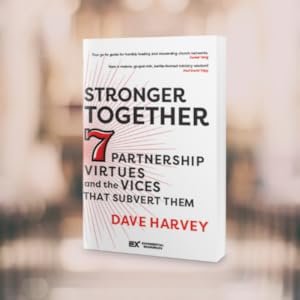
Stronger Together

By Dave Harvey (summary by Jeffrey Bush)

  • Partnership is a crucial piece to the puzzle of leadership longevity and mission
    impact.
  • Partnerships must be rooted in doctrinal conviction.
  • Partnerships are needed for a church planting movement.
  • Proud people don’t play well in the partnership sandbox.
  • Accountability doesn’t shadow innovation, it is essential to it.
  • The more gifted the leader, the more essential is the accountability.
  • Interdependence says we need each other, collaboration says let’s find a way to
    accomplish things together.
  • As the African proverb says, if you want to go fast, go alone. If you want to go far, go
    with others.
  • Ego seeks loyalty more than it does honesty.
  • The seed of egotism lies within each of us.