
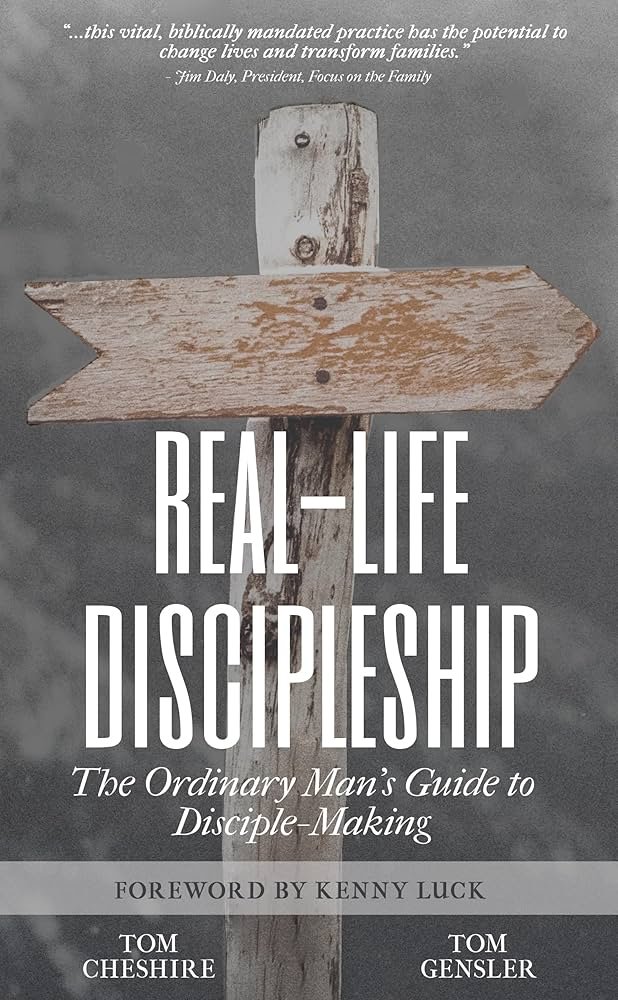
Real-Life Discipleship Book Review by Jeff Bush

By Tom Cheshire and Tom Gensler 

  • You can’t give away what you don’t possess.
  • If you were in a room of people and asked them about discipleship, almost everyone of them would refer to a person that helped them in their life.
  • Preaching is essential, but your preaching is not discipleship. 
  • Discipleship is 2 Timothy 2:2 in action.
  • Discipleship is the process of spiritual growth.
  • Jesus was not just telling disciples to be like Him, He was showing them how to live God-centered lives.
  • Discipleship is one individual investing in one or more other individuals on a consistent basis.
  • Which results more in your children listening — what you tell them to do or what they see you do? And this is what discipleship is about as well. 
  • You can and should be a disciple, as well as a disciple maker. 
  • You need to know who you are, but you also need to know Who’s you are. 
  • If you want others to follow your example, you must have been discipled and be discipling others.
  • Discipleship is not about perfection, but about progress.
  • Luke 6:12–13 teaches that before Jesus chose the disciples, He spent time in prayer.
  • Jesus always spoke to His Father. We would be wise to realize we cannot do anything on our own, we need God’s help. 
  • Discipleship is more caught than taught. Do not overcomplicate discipleship; recognize how Jesus walked and spent time investing in others.
  • Much of what you need to do with those you are discipling is to love them. 
  • In Luke 8, we see only 25% of the seed sown bears fruit. We should not be surprised that not everyone we disciple will bear fruit, but we still do our duty. 
  • The growth of an individual is not like a mushroom that shoots up quickly, rather like an oak that grows over a long period of time.
  • Discipleship is relational, it is life-on-life. 

Raising Grateful Kids In An Entitled Generation: Book Review by Jeff Bush

by Kristen Welch 

  • How can we explain or expect gratitude from our children if we are not showing it in our own lives.
  • Although our children should expect our love and acceptance, they must learn not to expect the material things this world places in front of them.
  • Entitlement winds its way through families. Everything from portion sizes, presents, activities, clothes and toys.
  • Resolving entitlement starts with teaching your children to be thankful for what they already have.
  • Entitlement has always been around, so maybe it’s the parenting that has changed and not the children. We are giving without making them earn, not saying no and overindulging.
  • Proverbs 22:6 has another side to it, a negative one. If you allow children to do whatever they want, they are not going to depart from their bad ways even when they’re old. 
  • Sometimes parents say no so often that they lose the opportunities to explain why they say no.
  • Sadly, parents feel pressured to give their children things they don’t necessarily need because everyone else is giving it to their children (best schools, sports, brand names, vacations, etc.).
  • Begin your quest for contentment. Is Jesus really enough for you?
  • The blurry line of being friend and parent is one of the most controversial lines in parenting today.
  • Kids need to learn how to problem solve. Parents do not need to rob this lesson from them.
  • We cannot make our parenting decisions based on what other parents are doing.
  • Temporary unhappiness from kids not getting their way can make for happiness as adults that love God and others.
  • Wanting our kids to be happy all the time might just be feeding their entitlement attitude.
  • Let your kids be devastated at age six so their first time is not when they are in college.
  • Tell your kids it’s more important who they are then what they have.
  • It is not your job as a parent to provide exciting activities every leisure moment. Kids are known for saying they are bored, but they need to learn to go outside, be creative and find things to do. 
  • Challenge your kids to turn their phone around and take pictures of others instead of themselves. Take them to a homeless shelter. Teach them to think of others.
  • Parents should make restrictions on their kid’s social media platforms/accounts, and should not feel bad about it.
  • You should ask and know your children’s passwords and accounts. This is not an invasion of privacy, it is protecting your children. There are predators and dangerous people out there that want to hurt your children.
  • We must teach our children self control. We will not always be with them to help make decisions, so they must learn to make decisions on their own. Proverbs 25:28
  • Obedience should be expected not suggested. But do so with grace and love.
  • Losing is good for your kids, not bad. Giving a participation trophy does not teach them about life, in fact, it makes them expect more.
  • Make your marriage more important than your children, it’s what you and your kids need. 
  • Nothing makes us more grateful than perspective.
  • The best way to teach gratitude is to model it. Do they see you saying thank you, writing a thank you card and being kind to the server at a restaurant?
  • You may get mad or feel you’ve messed up with your kids, but there’s time to ask forgiveness… so do it when necessary. 
  • Talking to older parents will help coach you as you’re raising your kids.
  • 7 Ways yo Teach Gratitude to our Kids, instead of Entitlement:
          1. Teach ownership. Chores and responsibilities. Their clothes and possessions. 
          2. Stress the value of money. Saving and spending money. Let them have an allowance for their work or an amount on vacation and not get more when it’s spent. It’s easier for them to spend your money than theirs. Teach and encourage them to give. 
          3. Emphasize the value of hard work. Make work part of your daily routine. Teach them to pick up after themselves as well as specific jobs around the house. Let them be in charge of making dinner and cleaning up after meals.
          4. Teach responsibility and consequences. Require them to do their own laundry when they get to a certain age, and when they run out of clean items don’t run to the rescue. It is hard to watch your kids fail, but sometimes that’s what they need to do. 
          5. See the benefits of delayed gratification. In a world of instant gratification children must learn to delay the immediate reward for the later reward. The reward that is worked for and waited for is usually much more valued. 
          6. Give your children a larger worldview. Perspective is one of the greatest gifts you can give your children and yourself, and service is a great way to package it. Not everyone in the world has what you have, many have far less. Your kids need to know that. Take them to work at a homeless shelter or places they can help and as see the need of others. Your family is at its best when you are helping serve others. 
          7. Strive to instill faithfulness. Persevering when things are hard is often rewarding. 
  • Don’t ground your children from spiritual activities. Sometimes parents will not let their children go to a church event because of the way they acted. But they need that influence more than other things they have or do in life.
  • One of the greatest gifts we can ask from the Lord is wisdom. 
  • Nothing we can do or say can ever substitute for bowing our heads and praying for our children. 
  • Prayer is often the last thing we think when raising kids, but God wants to walk this path with us. And there’s nothing greater than telling our parental needs to the One who parents us.

Planting by Pastoring Book Review by Jeff Bush

By Nathan Knight 

  • Don’t look at the best business models, look to God. 
  • We love size and speed, but a church can grow and be healthy without those. 
  • Most authors and church planters say that size and speed are important in church planting, but when we go to Scripture, the narrative of God is more on slowness. Consider Abraham and Sarah who were childless for 25 years after being told they would have a child. Consider Israel who was is in slavery in Egypt for 420 years. Or consider the coming of Christ in which thousands of years have passed.
  • The essence of a church is not their financial stability.
  • Multiplication does not come at the expense of depth. 
  • Planting by pastoring is glorious and grace filled, but it is not efficient. It takes time and energy. 
  • Evangelism is not the finish line in church planting. 
  • We want to know names, not just see numbers. We want to know stories, not just statistics. 
  • We plant churches to pastor people individually so we can worship Jesus collectively.
  • What if Jesus did not intend for churches to look like McDonald’s serving a billion people, rather look like your kitchen to serve your family and friends?
  • Pastor’s sacrifice for their sheep
  • Jesus knew His people and His people knew Him. He pastored them as names and not numbers.
  • The foundation of the church is Jesus and His Gospel. If you are a church planter, you should ask yourself what lies at the foundation of this thing that you are spending so much time building. 
  • Let the size and significance of the church you are planting take care of themselves. Slow down and press the Gospel into the lives of the people just as Jesus did.
  • The people need to know that you are wanting to help them, not get something from them. You are a pastor, not an entrepreneur.
  • Jesus gathered men before He ever held a public campaign or evangelistic effort.
  • A planter pastor must have character, competence, and compassion. 
  • Charisma might attract people on the front end, but it rarely endures. Your love for Jesus will keep you there, not your charisma. 
  • The power is in the Gospel. A magnetic personality and eloquent composure is nice to have, but they are bonus, extra, and unnecessary. 
  • If you are planting churches to be respected, heard, and esteemed, you are doing so for the wrong reasons.
  • Plant churches for the identity of Jesus, not to find or focus on your own identity.
  • Our areas do not need community centers and places of entertainment, they need a church where Christ is preached.
  • If you’re going to plant a church you need to be sent out by a church. A church that will love you and lead you.
  • A church planting team will minimize weaknesses and maximize effectiveness. Throughout the Bible, we see teams going out. Paul and Barnabas, Jesus and the disciples, and even many letters that Paul signed included a team of people.
  • In planting a church, we can get so involved with a list of what needs done and neglect our own souls. 
  • A team helps you with encouragement and accountability.
  • Prayer is your lifeline to God. Prayer is essential.
  • You should allow people to challenge your thinking. Is the place you are wanting to go truly a place of need? 
  • When, choosing a city, ask yourself if you are reflecting the need of Romans 15:19–20.
  • Preach, pray, love, and stay in a community. 
  • Love people, not programs.
  • Use as many evangelistic tools as possible, but one of the best tools will be the church members’ influence on other people.
  • Church planters can rest in God’s fruit as they faithfully scatter the seed.

Planting a Church Without Losing Your Soul: Book Review by Jeff Bush

By Tim Morey 

  • Spiritual competencies are as important, if not more, as other competencies.
  • You as the pastor are not meant to hold all of the church problems. If you try to do what only God can do, you will live anxious and exhausted. Be the Pastor and let God be God.
  • When Elijah was discouraged, God spoke to him about the physical: food, water, and sleep. The physical is connected to the spiritual.
  • Overeating and unhealthy eating is common for those in ministry, but it is not good.
  • Don’t wait until you break. Let God and others help you with your emotional needs.
  • Many church planters started a church, hoping for the story of someone else, but God might want to write your story differently.
  • God doesn’t always meet us in the way we want or expect, but He does always meet us how we need.
  • The number one problem of pastors is isolation.
  • The main thing you will give your congregation is the person you become – Dallas Willard 
  • Church planters become professionals at “winging it.” The problem is you cannot “wing” your spiritual life.
  • The church’s strengths and weaknesses mirror the pastors strengths and weaknesses.
  • Suffering contains the seeds for success.
  • Church planters often have a mixture of confidence and self-doubt. Humility is needed.
  • Suffering keeps me humble and aware of the things I do not know.
  • We fear suffering, but we should probably fear more the absence of suffering.
  • It seems in 2 Corinthians 12 that Paul’s greatest asset was his greatest weakness – and that very likely could be the case with each of us.
  • Are you able to embrace the difficulties as a gift from God? 
  • Without suffering, how could we develop empathy – helping people in an understanding way.
  • Power without love is reckless and abusive. Love without power is sentimental and anemic.
  • According to a survey at Duke University, 43% of US churches run less than 50 people. Another 24% are between 50-100 people. 21% are between 100–200 people. 10% are between 250-1000 people. And 2% are 1000 or more.
  • A study from Harvard Institute for religion says the median size of a church in the US is 80 people. Only half of 1% of churches in the US are mega churches (2,000 plus people). 
  • We should focus more on making big Christians instead of trying to make big churches.
  • We must move from being superheroes to equippers.
  • If you as the pastor are doing the bulk of ministry, you are doing it wrong. Ephesians 4 teaches that the pastor is to equip others, not just do all the work.
  • Teaching others to do what you do means you don’t get to be the hero. 
  • Before we deal with difficult people, we must face the issues with the man in the mirror.
  • If you lose your family, you lose your ministry as well.
  • Do you want your kids to grow up loving church or hating church? Do you want your spouse to be thankful they married someone in the ministry, or regret it?
  • To succeed in church and fail in your family is to fail.
  • As a church planter, you will likely not have as much money as the people in your church, but you do have more power over your schedule than others do. You can use this to your strength to make sure you have time for your family.
  • Most church planters feel like they can’t get away, but a healthy church needs their pastor to be absent so they can learn to take care of areas. Your family and your church need you to get away.

People Can’t Drive You Crazy If You Don’t Give Them The Keys : Book Review by Jeff Bush

By Mike Bechtle 

  • Drama free doesn’t mean ridding of the drama, or the people that create it, rather the affect it has in you.
  • When it comes to drama, you have three choices: 
    1. Get the crazy person to change. 
    2. Live with the craziness. You can learn to accept it. 
    3. Get the crazy person out of your life. You can leave the situation.
  • Your relationship with God will help your relationship with others. 
  • When you determine to grow in spiritual maturity you’ll be able to better deal with drama and craziness.
  • We all have drama in our lives, but some people are controlled by it.
  • Our emotions are based on assumptions. The problem with assumptions is that we are basing solely on the facts that we have. 
  • Proverbs 18:17 teaches that our arguments make sense until we hear the other side.
  • False hopes destroy a relationship. While you’re expecting the other person to change, they likely are hoping for the same thing.
  • 5 truths about relationships:
          1. People with the most drama are the ones we spend the most time with (friends, family, coworkers, etc.). 
          2. Relationships take work.
          3. Relationships take time.
          4. The past doesn’t have to dictate the future.
          5. You don’t have to be the victim. 
  • When people are angry, they do not make logical decisions. 
  • The key to surviving crazy people is determining what we can and cannot control. We can control ourselves, but not others.
  • If each of us try to see how the other person sees, we’re laying the foundation for a good relationship.
  • If we want to best know how to use our car, we read the instruction manual. If we want to best know how to deal with other people, we read the instructions from the One who made people.
  • The key to managing our emotions is learning to manage our thoughts. 
  • Feelings come and go but love remains, and we are commanded to love. 
  • Realize that people are not accountable to you.
  • Reactive people focus on the problems while responsive people focus on the positive.