
Jerry Falwell: Aflame for God Book Review by Jeff Bush

By Gerald Strober & Ruth Tomczak

  • It is evident that Jerry loves young people and those things that interest them. “Years ago,” he says, “I decided that if I had to make my life count for eternity, I would do as the Lord did, and as the apostle Paul did — reproduce myself in others and teach them the same reproductive principles. I think for the rest of my life the major part of my ministry will be gathering young men and women around me and reproducing in them what God has reproduced in me.” — Page 88-89


  • Jerry’s vast ministry to people necessitates that he travel a great deal. When he is away from home, he calls Macel and his children at least once a day. He talks to Macel, Jerry Jr., Jeannie, and Jonathan and prays with each individually. He often says to mothers and fathers, “You had better make your family your priority, because that is God’s priority for you. You may have all the world against you, but if you have a loving spouse and children who love one another, your home will be a fortress. It will be a refuge to which you run. A true Christian home is the most heavenly thing on this earth. It is characterized by peace and serenity and is a place of happiness.” — Page 113
  • “How strong is a man?” Jerry Falwell asks his congregation and the approximately 20 million viewers of the Old-Time gospel Hour. “He is only as strong as is his relationship to Christ.” — Page 115
  • When asked his ultimate dream, Jerry Falwell says, “I believe this is the terminal generation before Jesus comes. My ultimate desire is to glorify God by giving the gospel of Jesus Christ to every creature in my generation – somehow.” — Page 120
  • Jerry always said First, ‘Nothing of eternal value is ever accomplished apart from prayer;’ second, “The difference between greatness and mediocrity is vision;’ and third, ‘You determine a man’s greatness not by his talent or wealth as the world does, but rather by what it takes to discourage him.’ — Page 136
  • “There is no limit to the power of prayer,” says Jerry. “God loves His children and is concerned about every detail of their lives. God will answer our prayers – not always as we wish them answered, but always in accordance with His will and for our good. Jesus does all things well. Let us claim the promises of God through prayer. I am convinced that if we are to reach the world for Christ in this generation, we must train and mobilize a mighty army of praying people. The great movings of God in every generation have had their beginning in prayer meetings.” “A great moving of God” is what Jerry desires the church to be characterized by. Pray for the power of the Holy Spirit to be evidenced in every one of our ministries.”— Page 143-144
  • “The real mission of the New Testament church is to reach the world with the gospel of Jesus Christ. We are to begin at Jerusalem, but we are also to go on to the uttermost parts of the earth. God has given us a burden to start at least five thousand new churches on the North American continent in the next five years. We have asked God to plant literally hundreds of missionaries all over the planet who will likewise be establishing New Testament churches. The hope of our nation, and for the world, is in the establishment of local, New Testament churches that will reach and teach the people of our generation and mobilize them to participate in world evangelization.” — Page 145


Indistractable Book Review by Jeff Bush

By Nir Eyal and Julie Li 

  • We must stop doing the wrong things, but we must start doing the right things. 
  • We already know what to do, but we don’t know how to stop being distracted. 
  • If your superpower could be being indistractable, you could spend more time with family, get more work done, and accomplish more. 
  • Distractions will always exist, but managing them is our responsibility. 
  • Most people do not want to admit that distractions are an escape from reality. 
  • Time management is pain management. 
  • People go to extremes to not be bored. 
  • If we want to master distraction, we must learn to deal with discomfort. 
  • While we can’t control all the thoughts that pop into our head, we can control what we do with them. 
  • You it can’t call something a distraction unless you know what it’s distracting you from.
  • Planning ahead is the only way to know the difference between traction and distraction. 
  • There’s nothing wrong with a nap, game, or relaxing if that’s what you’ve planned to do. 
  • Input is more certain than output. You can’t control what you get out of something but you can control how much time you put into it. 
  • The people you love deserve more than just getting whatever time is leftover. Go the next step to plan time with them on your calendar. 
  • Clarify your values. 
  • To get the most out of your phone:
      1. Remove apps you no longer need.
      2. Replace apps with profitable ones that line up with your values.
      3. Rearrange according to the most important apps on your home screen and make the others not so easily accessible.
      4. Reclaim by adjusting notifications, only allowing a few apps to make noise and notify you. 
  • Hack back your desktop or laptop. A cluttered Home Screen is not only messy, but it controls distractions. 
  • Teach children how to be indistractable. It is a quality that will help them throughout all their lives.
  • Children must see indistractable modeled by their parents.
  • Internal struggles triggers drive behavior.
  • Screens and sleep do not mix well.
  • Teach children how to swim before diving in. They should learn how to ignore distractions before given a device with dangerous features.

I Am Going Book Review by Jeff Bush

By Daniel L. Akin 

  • We cannot fulfill the Great Commission without the church.
  • The local church sends, and church members go. 
  • Fulfilling the Gospel advance will vary from Christian to Christian and church to church. The key to Biblical obedience is that we are actively doing something in our Jerusalem, our Judea, our Samaria, and the ends of the earth. 
  • Where did we ever get the idea that serving King Jesus is supposed to be safe?
  • Last words are meant to be lasting words, and Jesus’ last words were to go make disciples amongst the nations. 
  • Is there a cost in being a Great Commission Christian? The answer is yes, but it’s the same cost that is involved in being a disciple of Jesus. Mark 8:34-38
  • Sadly, today the normal Christian life looks to many as to be the radical Christian life.
  • Not every person will go to the nation, but every person has a responsibility to the nations.
  • We must ask ourselves two questions: what is my part, and am I doing my part?
  • God calls every Christian to be a Great Commission Christian.
  • Every Christian is to go or send.
  • God calls His children to honor Him in at least four different ways: 
          1. In our church as church members
          2. In our home
          3. In our community 
          4. In our work

I Am A Church Member Book Reviews by Jeff Bush

By Thom S. Rainer 

  • Too many people have an unbiblical view of church membership. They see it more as a country club membership where they get what they want and don’t want to be disturbed.
  • Church membership is founded on love. 
  • Church membership is founded on functioning membership. Give, attend, study, evangelize, and participate.
  • Be a unified church member. God commands for His children to get along.
  • Unity is vital to a church. When the church works together, it works as a whole. 
  • When we seek unity, we demonstrate love.
  • Few things can destroy the unity of a church like gossip.
  • Unity will not happen in the church unless there’s forgiveness.
  • Churches are made up of imperfect pastors and imperfect people. You will be hurt. But unless you forgive, there will be no unity.
  • Decide you will not make the church about your preferences and your desires.
  • In Mark 9, the disciples, those with closest to Jesus, had a me-first argument. 
  • We will never find joy in church membership when we are seeking ourselves first. 
  • Be a church member that prays for the church leaders.
  • Pray for his family, preaching, protection, physical and mental health. and pray for him every day. 
  • Be a church member that teaches your family to love the church. Pray together as a family for your church.
  • Treasure your church membership as a gift.
  • When we are thankful for something, we have less time to criticize and think negatively of it.

How to Tell A Story Book Review by Jeff Bush

By The Moth, Meg Bowles, Catherine Burns, Jenifer Hixson, Sarah Austin Jenness and Kate Tellers

  • Stories are what turns friends into family.
  • Your stories are like fingerprints; they are unique to you.
  • Vulnerability is power when it comes to telling a story. 
  • We are all bursting with stories, dig within so find them. 
  • If you don’t feel it, your audience won’t feel it.
  • Tension keeps the audience on the edge of their seats. They want to know what is about to happen or where this story is going.
  • You are not just telling what happened in the story, you are telling why it is important.
  • How can you boil your story down into one sentence. Being able to do that will help guide in shape the story you want to tell.
  • As a storyteller, you are in charge of the journey, the scenes you show people, where you stop, what you overlook and your final destination.
  • Tell the story as if you were in it right now and feeling it.
  • Resist the urge to tell the listeners how they should feel, let them decide on their own.
  • Details make the story memorable to your listeners.
  • Emotions will connect you with your audience.
  • When telling a story, you have to take your listener somewhere. You cannot keep going around the block.
  • The ending is the last thing you say, so it can hurt your entire story.
  • Preparation is your key to confidence on the stage.
  • Let your text be a roadmap. You do not need to know every word, just know that you are going in the right direction.
  • Although you do not need to memorize your entire speech, you should memorize or know super well the opening and closing.
  • Repetition can be a spotlight. It can help the audience remember and know what is important.
  • There is no need for big words or flowery talk. Speak like you talk and not like you would read.
  • Stories should feel off the cuff, but they should not be off the cuff. Prepare, practice, and rehearse. 
  • See it in your mind as you are telling it and it will help in your delivery. 
  • As long as you are willing to be vulnerable, you have a story to tell.
  • Find a way to calm your nerves, whatever works for you. 
  • You are much more likely to remember a fact if it is wrapped up in a story.

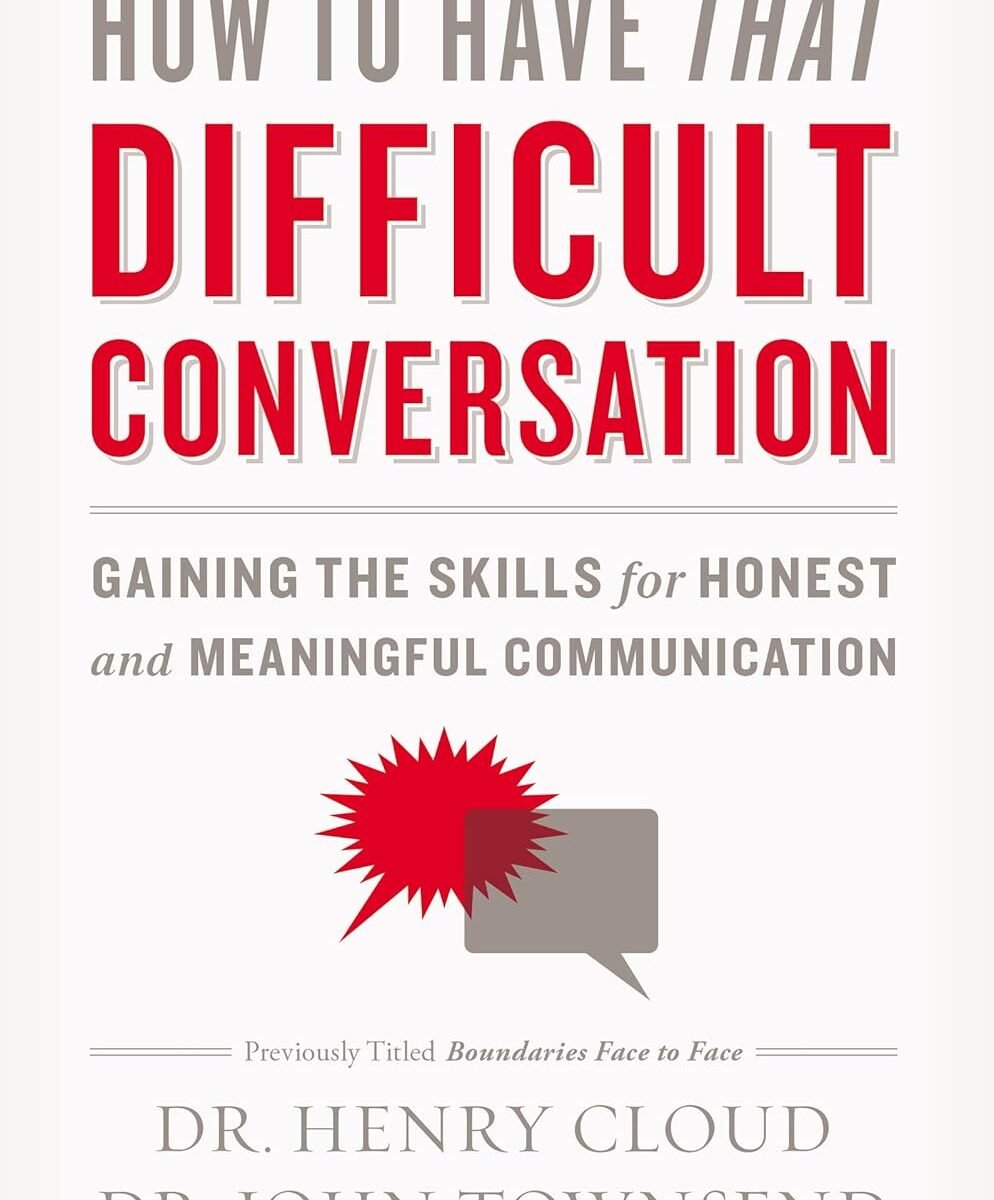
How to Have That Difficult Conversation Book Review by Jeff Bush

By Dr. Henry Cloud and Dr. John Townsend 

  • When someone says they need to talk to us, we often become very anxious and fearful.
  • We fear the talk is going to be about rejection or will be painful, so we put off the difficult conversation. 
  • Probably the greatest benefit from having the confrontation is that it preserves the love in a relationship.
  • Nothing is more unpleasant than having a relationship with someone yet being disconnected. 
  • Be clear between “you” and “I.” You do not enjoy it when someone puts words in your mouth, so do not do that to the person you are speaking to.
  • Speak from your own mind, experience and heart, not putting it on them. 
  • Be clear about the nature of your problem.
  • Make the issue as clear as possible to the other person. They may be unaware of the problem. 
  • Clarify the affects of the problem. 
  • Clarify your desire for change. Let them know what you would like to see, and what would solve the problem. Do not leave it at dumping the negative on them.
  • Balance grace and truth. Look at God’s example in this area. Psalms 85:10
  • Don’t blame, just inquire. 
  • Affirm and validate the people you confront so they know they are valued. It’s grace before truth. 
  • If you’re going to confront, make sure you have a clean slate first by apologizing if needed. 
  • Don’t use the word “need” if it’s actually a want. Say, “I would like.”
  • Only until a person is aware of a problem are they responsible for it. 
  • Assume a person is innocent or does not know the severity. 
  • Use Micah 6 
        1. Do justly
        2. Love mercy
        3. Walk humbly before God
  • Go hard on the issue but soft on the person. 
  • There are three things on the table: you, the other person, and the issue. 
  • Remember confronting is a dialogue, not a monologue. 
  • Remember that forgiveness of the past doesn’t mean trust for the future. 
  • Ask the person to repeat back to you what you said, that way you know they understand your intention. 
  • Speaking the truth in love is God’s way of confrontation. 
  • It is good to want and desire positive outcomes, but you cannot demand them.

How Joyful People Think Book Review by Jeff Bush

By Jamie Rasmussen 

  • Think positively, possibilities, and problem-solving. These three steps will help you.
  • Philippians 4:8–9, Paul uses the word “whatsoever.” He indicates what specifically we are to think on.
  • When things are not easy, and there’s nothing else you can do, you can always praise.
  • You might have a bad day, but you can choose joy.

Homiletics from the Heart Book Review by Jeff Bush

By Dr. John Goetsch

  • God doesn’t call according to your gifts, He gifts according to your call! 
  • Preaching cannot be separated from all that a minister is.
  • The outer must be preceded by the inner; public life, for God, must be preceded by private life with God; unless God has for spoken to man, it is vain for a man to attempt to speak for God. Before he begins to make God known, he should first himself know God. – Dr. James Stalker
  • The minister is as much the message as the sermon.
  • Before we can learn how to preach, we must learn how to live.
  • No one can effectively distribute the truth of the gospel without first being a partaker himself.
  • Better to abolish pulpits than fill them with men who have no experimental knowledge of what they teach – Charles Spurgeon
  • Preaching is “truth” and “personality.” They cannot be separated, but rather the messenger and the message must be in perfect harmony to achieve God’s results.
  • It is possible for a man to be regenerate, and to be a minister, and yet to remain worldly, shallow, undeveloped and unsanctified. – Dr. James Stalker
  • God’s may bless our homiletical outline, our illustrations and stories, our delivery, etc., but He does not promise to do so. He only promises to bless His Word, “For as the rain cometh down, and the snow from heaven, and returneth not thither, but watereth the earth, and maketh it bring forth and bud, that it may give seed to the sower, and bread to the eater: So shall my word be that goeth forth out of my mouth: it shall not return unto me void, but it shall accomplish that which I please, and it shall prosper in the thing whereto I sent it.” (Isaiah 55:10–11)
  • We must never forget that we are not called to stand in the pulpit, and preach ourselves, our philosophy, our experiences, or even our beliefs. We are commanded to “preach the Word!”
  • The Bible is the supreme preacher to the preacher. – P.T. Forsyth 
  • God always deals with the preacher first. As stated earlier, the man affects the message. If the man is not affected by the message, the message will have no effect.
  • Before a man proclaims the message of the Bible to others, he should live with that message himself. God is more interested in developing “messengers” than He is “messages.” A preacher must learn to listen to God before he speaks for Him.
  • There are three types of preachers: those to whom you “cannot” listen; those to whom you “can” listen; and those to whom you “must” listen. During the introduction the congregation usually decides what kind of speaker is addressing them that day. — Haddon Robinson
  • Restatement is different than repetition. Repetition is saying the same thing in the same words, while restatement is saying the same thing in different words. The skillful preacher will learn to restate a point several times in different ways.
  • Your principles and points will appeal to the mind while your illustrations will appeal to the heart.
  • Preaching is not preaching unless people are brought to a decision. — Dr. Martin Lloyd Jones
  • Complicated words and sentences will draw attention to “you” rather than God’s message.
  • The key to powerful, effective preaching, is already in the ignition. We can choose to push the car ourselves, or we can engage his power. It is our choice!