
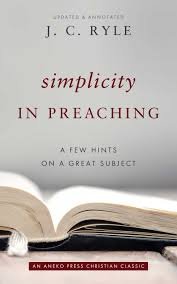
Simplicity in Preaching Book Review by Jeff Bush

By JC Ryle 

  • Unless you are simple in your preaching, you cannot be understood, and if you cannot be understood, you are of no good to the listeners. 
  • No greater mistake can be made than supposing you can easily be understood. 
  • The majority of preachers preach over the head of their listeners. 
  • It is not easy to write a clear and straightforward sermon that can be easily understood. 
  • To write what is simple, striking. and easily understood is a rather hard thing. 
  • If you are going to attain simplicity in preaching, you must have a good understanding of your subject. 
  • Do not preach on an obscure passage that you do not know or understand. 
  • Be careful of spiritualizing and drawing out something that the Holy Spirit never put in the text. 
  • If you want to be simple, there must be order your sermon.
  • If you do not understand a passage or subject, you cannot make it simple; and if you do not make it simple, it will not be understood.
  • Use simple words. Simple words, are not words of one syllable rather words that are commonly used.
  • Use antidotes and illustrations. Look at the sermons of Jesus, He referred to the birds of the air, the fish of the sea, the sheep, the goats, etc.
  • The best speaker can turn the ear into an eye, causing people to imagine and see.
  • You will never preach with simplicity without a lot of hard work. Take time to prepare and develop your sermons.
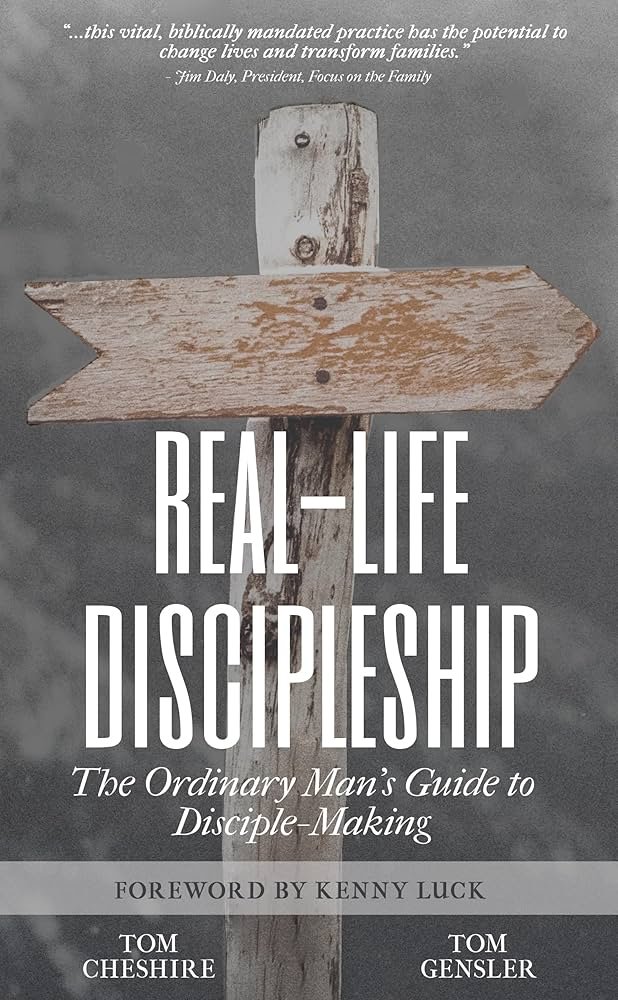
Real-Life Discipleship Book Review by Jeff Bush

By Tom Cheshire and Tom Gensler 

  • You can’t give away what you don’t possess.
  • If you were in a room of people and asked them about discipleship, almost everyone of them would refer to a person that helped them in their life.
  • Preaching is essential, but your preaching is not discipleship. 
  • Discipleship is 2 Timothy 2:2 in action.
  • Discipleship is the process of spiritual growth.
  • Jesus was not just telling disciples to be like Him, He was showing them how to live God-centered lives.
  • Discipleship is one individual investing in one or more other individuals on a consistent basis.
  • Which results more in your children listening — what you tell them to do or what they see you do? And this is what discipleship is about as well. 
  • You can and should be a disciple, as well as a disciple maker. 
  • You need to know who you are, but you also need to know Who’s you are. 
  • If you want others to follow your example, you must have been discipled and be discipling others.
  • Discipleship is not about perfection, but about progress.
  • Luke 6:12–13 teaches that before Jesus chose the disciples, He spent time in prayer.
  • Jesus always spoke to His Father. We would be wise to realize we cannot do anything on our own, we need God’s help. 
  • Discipleship is more caught than taught. Do not overcomplicate discipleship; recognize how Jesus walked and spent time investing in others.
  • Much of what you need to do with those you are discipling is to love them. 
  • In Luke 8, we see only 25% of the seed sown bears fruit. We should not be surprised that not everyone we disciple will bear fruit, but we still do our duty. 
  • The growth of an individual is not like a mushroom that shoots up quickly, rather like an oak that grows over a long period of time.
  • Discipleship is relational, it is life-on-life. 

Planting a Church Without Losing Your Soul: Book Review by Jeff Bush

By Tim Morey 

  • Spiritual competencies are as important, if not more, as other competencies.
  • You as the pastor are not meant to hold all of the church problems. If you try to do what only God can do, you will live anxious and exhausted. Be the Pastor and let God be God.
  • When Elijah was discouraged, God spoke to him about the physical: food, water, and sleep. The physical is connected to the spiritual.
  • Overeating and unhealthy eating is common for those in ministry, but it is not good.
  • Don’t wait until you break. Let God and others help you with your emotional needs.
  • Many church planters started a church, hoping for the story of someone else, but God might want to write your story differently.
  • God doesn’t always meet us in the way we want or expect, but He does always meet us how we need.
  • The number one problem of pastors is isolation.
  • The main thing you will give your congregation is the person you become – Dallas Willard 
  • Church planters become professionals at “winging it.” The problem is you cannot “wing” your spiritual life.
  • The church’s strengths and weaknesses mirror the pastors strengths and weaknesses.
  • Suffering contains the seeds for success.
  • Church planters often have a mixture of confidence and self-doubt. Humility is needed.
  • Suffering keeps me humble and aware of the things I do not know.
  • We fear suffering, but we should probably fear more the absence of suffering.
  • It seems in 2 Corinthians 12 that Paul’s greatest asset was his greatest weakness – and that very likely could be the case with each of us.
  • Are you able to embrace the difficulties as a gift from God? 
  • Without suffering, how could we develop empathy – helping people in an understanding way.
  • Power without love is reckless and abusive. Love without power is sentimental and anemic.
  • According to a survey at Duke University, 43% of US churches run less than 50 people. Another 24% are between 50-100 people. 21% are between 100–200 people. 10% are between 250-1000 people. And 2% are 1000 or more.
  • A study from Harvard Institute for religion says the median size of a church in the US is 80 people. Only half of 1% of churches in the US are mega churches (2,000 plus people). 
  • We should focus more on making big Christians instead of trying to make big churches.
  • We must move from being superheroes to equippers.
  • If you as the pastor are doing the bulk of ministry, you are doing it wrong. Ephesians 4 teaches that the pastor is to equip others, not just do all the work.
  • Teaching others to do what you do means you don’t get to be the hero. 
  • Before we deal with difficult people, we must face the issues with the man in the mirror.
  • If you lose your family, you lose your ministry as well.
  • Do you want your kids to grow up loving church or hating church? Do you want your spouse to be thankful they married someone in the ministry, or regret it?
  • To succeed in church and fail in your family is to fail.
  • As a church planter, you will likely not have as much money as the people in your church, but you do have more power over your schedule than others do. You can use this to your strength to make sure you have time for your family.
  • Most church planters feel like they can’t get away, but a healthy church needs their pastor to be absent so they can learn to take care of areas. Your family and your church need you to get away.