
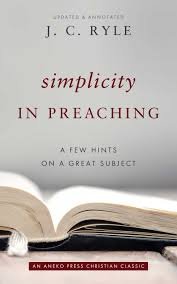
Simplicity in Preaching Book Review by Jeff Bush

By JC Ryle 

  • Unless you are simple in your preaching, you cannot be understood, and if you cannot be understood, you are of no good to the listeners. 
  • No greater mistake can be made than supposing you can easily be understood. 
  • The majority of preachers preach over the head of their listeners. 
  • It is not easy to write a clear and straightforward sermon that can be easily understood. 
  • To write what is simple, striking. and easily understood is a rather hard thing. 
  • If you are going to attain simplicity in preaching, you must have a good understanding of your subject. 
  • Do not preach on an obscure passage that you do not know or understand. 
  • Be careful of spiritualizing and drawing out something that the Holy Spirit never put in the text. 
  • If you want to be simple, there must be order your sermon.
  • If you do not understand a passage or subject, you cannot make it simple; and if you do not make it simple, it will not be understood.
  • Use simple words. Simple words, are not words of one syllable rather words that are commonly used.
  • Use antidotes and illustrations. Look at the sermons of Jesus, He referred to the birds of the air, the fish of the sea, the sheep, the goats, etc.
  • The best speaker can turn the ear into an eye, causing people to imagine and see.
  • You will never preach with simplicity without a lot of hard work. Take time to prepare and develop your sermons.

Simple Discipleship Book Review by Jeff Bush

By Dana Allin

  • Discipleship is more of a journey than it is an event. 
  • Making disciples is the primary task to which Jesus calls us.
  • Many churches know that making disciples is a core value of the church, and will even put it in their mission statement, but are failing at doing it.
  • Discipleship, which is helping others love Jesus more, has too often been overcomplicated.
  • A reason we’ve failed in making disciples is because we do not have a clear, Biblical understanding of what a disciple of Jesus is to look like. 
  • If the church helps people love God with their heads and hands, yet not with their hearts, they’re doing a great disservice.
  • As churches, we sometimes confront discipleship as everyone needs to grow in the same areas, but that is not always the case.
  • We are not only saved by grace, but we continue to grow in grace as disciples of Christ.
  • Discipleship is so much more than dispensing information. A big misconception is that the more information we have, the more transformation will occur.
  • True discipleship is about being transformed.
  • Discipleship transformation does not happen at a microwave speed.
  • To disciple, a person should know you care for them and they’re not just a project. 
  • True growth takes time and intentional effort.
  • A mistake in discipleship is feeling you have to be a mentor, which is one who has more experience. It is good to see yourself as a coach, which doesn’t mean you are better than the other person, yet you are drawing out the best of the other person.
  • Clarify your goal as where you want the person to be after completing discipleship.
  • Be careful as you give advice. Do not try to offer solutions for everything they ask, rather ask questions questions that will help them think through what they need to do.
  • If you can help disciples, think for themselves, they will be better prepared to disciple others in the future.