
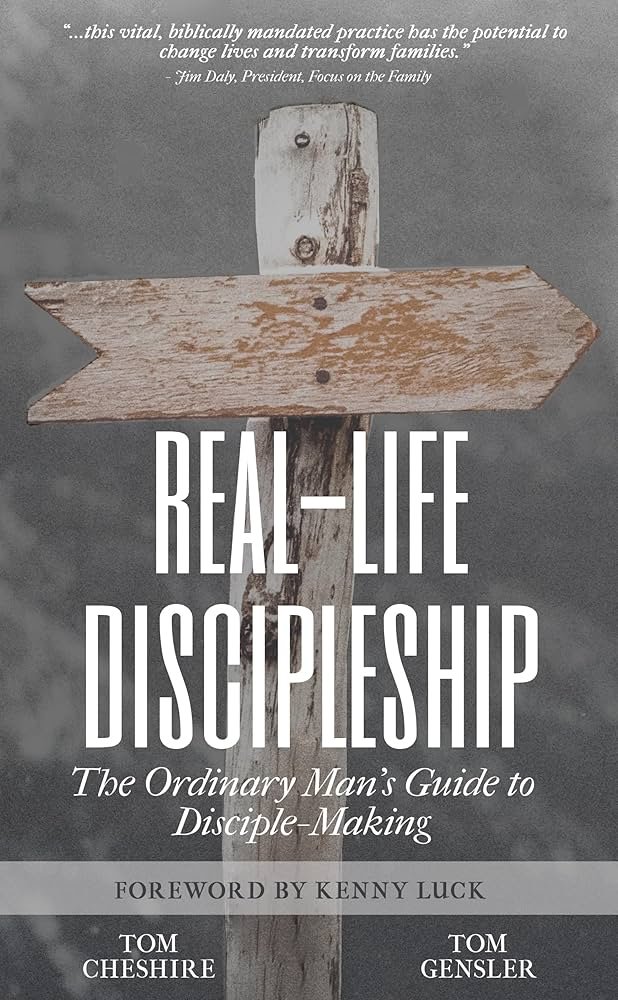
Real-Life Discipleship Book Review by Jeff Bush

By Tom Cheshire and Tom Gensler 

  • You can’t give away what you don’t possess.
  • If you were in a room of people and asked them about discipleship, almost everyone of them would refer to a person that helped them in their life.
  • Preaching is essential, but your preaching is not discipleship. 
  • Discipleship is 2 Timothy 2:2 in action.
  • Discipleship is the process of spiritual growth.
  • Jesus was not just telling disciples to be like Him, He was showing them how to live God-centered lives.
  • Discipleship is one individual investing in one or more other individuals on a consistent basis.
  • Which results more in your children listening — what you tell them to do or what they see you do? And this is what discipleship is about as well. 
  • You can and should be a disciple, as well as a disciple maker. 
  • You need to know who you are, but you also need to know Who’s you are. 
  • If you want others to follow your example, you must have been discipled and be discipling others.
  • Discipleship is not about perfection, but about progress.
  • Luke 6:12–13 teaches that before Jesus chose the disciples, He spent time in prayer.
  • Jesus always spoke to His Father. We would be wise to realize we cannot do anything on our own, we need God’s help. 
  • Discipleship is more caught than taught. Do not overcomplicate discipleship; recognize how Jesus walked and spent time investing in others.
  • Much of what you need to do with those you are discipling is to love them. 
  • In Luke 8, we see only 25% of the seed sown bears fruit. We should not be surprised that not everyone we disciple will bear fruit, but we still do our duty. 
  • The growth of an individual is not like a mushroom that shoots up quickly, rather like an oak that grows over a long period of time.
  • Discipleship is relational, it is life-on-life. 

Raising Grateful Kids In An Entitled Generation: Book Review by Jeff Bush

by Kristen Welch 

  • How can we explain or expect gratitude from our children if we are not showing it in our own lives.
  • Although our children should expect our love and acceptance, they must learn not to expect the material things this world places in front of them.
  • Entitlement winds its way through families. Everything from portion sizes, presents, activities, clothes and toys.
  • Resolving entitlement starts with teaching your children to be thankful for what they already have.
  • Entitlement has always been around, so maybe it’s the parenting that has changed and not the children. We are giving without making them earn, not saying no and overindulging.
  • Proverbs 22:6 has another side to it, a negative one. If you allow children to do whatever they want, they are not going to depart from their bad ways even when they’re old. 
  • Sometimes parents say no so often that they lose the opportunities to explain why they say no.
  • Sadly, parents feel pressured to give their children things they don’t necessarily need because everyone else is giving it to their children (best schools, sports, brand names, vacations, etc.).
  • Begin your quest for contentment. Is Jesus really enough for you?
  • The blurry line of being friend and parent is one of the most controversial lines in parenting today.
  • Kids need to learn how to problem solve. Parents do not need to rob this lesson from them.
  • We cannot make our parenting decisions based on what other parents are doing.
  • Temporary unhappiness from kids not getting their way can make for happiness as adults that love God and others.
  • Wanting our kids to be happy all the time might just be feeding their entitlement attitude.
  • Let your kids be devastated at age six so their first time is not when they are in college.
  • Tell your kids it’s more important who they are then what they have.
  • It is not your job as a parent to provide exciting activities every leisure moment. Kids are known for saying they are bored, but they need to learn to go outside, be creative and find things to do. 
  • Challenge your kids to turn their phone around and take pictures of others instead of themselves. Take them to a homeless shelter. Teach them to think of others.
  • Parents should make restrictions on their kid’s social media platforms/accounts, and should not feel bad about it.
  • You should ask and know your children’s passwords and accounts. This is not an invasion of privacy, it is protecting your children. There are predators and dangerous people out there that want to hurt your children.
  • We must teach our children self control. We will not always be with them to help make decisions, so they must learn to make decisions on their own. Proverbs 25:28
  • Obedience should be expected not suggested. But do so with grace and love.
  • Losing is good for your kids, not bad. Giving a participation trophy does not teach them about life, in fact, it makes them expect more.
  • Make your marriage more important than your children, it’s what you and your kids need. 
  • Nothing makes us more grateful than perspective.
  • The best way to teach gratitude is to model it. Do they see you saying thank you, writing a thank you card and being kind to the server at a restaurant?
  • You may get mad or feel you’ve messed up with your kids, but there’s time to ask forgiveness… so do it when necessary. 
  • Talking to older parents will help coach you as you’re raising your kids.
  • 7 Ways yo Teach Gratitude to our Kids, instead of Entitlement:
          1. Teach ownership. Chores and responsibilities. Their clothes and possessions. 
          2. Stress the value of money. Saving and spending money. Let them have an allowance for their work or an amount on vacation and not get more when it’s spent. It’s easier for them to spend your money than theirs. Teach and encourage them to give. 
          3. Emphasize the value of hard work. Make work part of your daily routine. Teach them to pick up after themselves as well as specific jobs around the house. Let them be in charge of making dinner and cleaning up after meals.
          4. Teach responsibility and consequences. Require them to do their own laundry when they get to a certain age, and when they run out of clean items don’t run to the rescue. It is hard to watch your kids fail, but sometimes that’s what they need to do. 
          5. See the benefits of delayed gratification. In a world of instant gratification children must learn to delay the immediate reward for the later reward. The reward that is worked for and waited for is usually much more valued. 
          6. Give your children a larger worldview. Perspective is one of the greatest gifts you can give your children and yourself, and service is a great way to package it. Not everyone in the world has what you have, many have far less. Your kids need to know that. Take them to work at a homeless shelter or places they can help and as see the need of others. Your family is at its best when you are helping serve others. 
          7. Strive to instill faithfulness. Persevering when things are hard is often rewarding. 
  • Don’t ground your children from spiritual activities. Sometimes parents will not let their children go to a church event because of the way they acted. But they need that influence more than other things they have or do in life.
  • One of the greatest gifts we can ask from the Lord is wisdom. 
  • Nothing we can do or say can ever substitute for bowing our heads and praying for our children. 
  • Prayer is often the last thing we think when raising kids, but God wants to walk this path with us. And there’s nothing greater than telling our parental needs to the One who parents us.

Perspectives on Missions Book Review by Jeff Bush

by Dr. Don Sisk

  • There are many enemies. If you do not believe it, consider this: there are more than 5 million fundamental Baptist Christians in America today. But these 5 million Christians have fewer than 5000 foreign missionaries., Which means it takes 1000 fundamental Baptist to go to get one missionary on the field. Last year, less than $75 million was given through all fundamental Baptist mission agencies for worldwide evangelization. This represent approximately $15 per fundamental Baptist per year for foreign missions. This is enough to convince anyone that to the average person, missions is not considered obligatory, but optional. Many show a token interest in worldwide evangelization, but only a few our whole heartedly involved. — page 21
  • When He directs people, He has a purpose for them. God prepares the fields before He directs the workers. — page 23
  • The Moravians had such a missionary zeal that 1 out of every 92 members of their congregations were serving God on a foreign mission field. It was not long before the Moravians in foreign countries, outnumbered the Moravians in Germany by 3 to 1. I do not know that there has ever been a more intensified effort on any group to get the gospel out around the world than this group. — page 25-26
  • I believe the missionary should plan his furlough around his work, instead of planning his work around his furlough. — page 39
  • In June (1990), BIMI will be 30 years old. I try to check our pulse regularly. I have a phobia of being a part of something that has lost its purpose. I have a fear of having a name that we live, but are dead (Revelation 3:1). A wise man once said, “Many Christian institutions are dead, but we can’t bury them because they are too heavily endowed.” — page 63
  • As I check our pulse, I must say: “Praise God, we’re alive! Let’s not go to sleep on the job. Let’s not rest on our past and become useless for the present and lose our opportunities for the future.” 
  • I have some visions for our 30th anniversary year:
        1. A gain of 30 missionary couples per year for the next 10 years. (Since every mission loses missionaries each year by death, retirement, etc., we must have at least 60 new missionaries each year.) This would give us 1200 active missionaries by the year 2000.
        2. Thirty new supporting churches for the home office each year. (Administrative cost increase each year. We must have help from churches to keep down the cost for the missionaries.)
        3. Thirty new fields opened in the next 10 years. (There are more opportunities now than at any time in the history of BIMI.)
        4. Thirty new churches established by our missionaries each year for the next 10 years.
  • We are alive! Will you allow us to help you? As your church thinks about missions, would you let us suggest some missionaries? Could we help you in your missionary conference? As you consider the mission field, would you consider BIMI as your mission? Pastor, would you recommend to your church BIMI for monthly support? — page 63-64
  • Someone has well said, “God accepts us as we are, but He loves us too much to leave us as we are.” — page 67
  • How sad, but throughout Christian history, some have come to believe “If I said it, you should believe it.” No man should assume that, and none of us should give any man that kind of allegiance. Any man can make a mistake, and any man can be replaced. We are instruments. God changes instruments, but God does not change. He buries his workmen, but his work goes on. — page 78-79
  • The cry of a Mexican pastor, Brother Enoch, continues to ring in my ear as I remember hearing him say, “There is enough of the Bread of Life to feed the whole world. There’s enough of the Light of the World to enlighten every person who lives on the face of the earth. There’s enough of the Water of Life to quench the thirst of every thirsty soul in the whole world. But the great majority of the people of the world know nothing about the Bread of Life. They know nothing about the Light of the World. They know nothing about the Water of Life.” — page 138
  • Perhaps there are 200 Bible-believing, Gospel-preaching churches in this (Mexico City) city. There’s about 1 Christian worker for every 300,000 people. In contrast, there is about 1 for every 150 people in Chattanooga, Greenville, Dallas, Jacksonville, and Memphis. On we could go naming cities in America, where the Gospel has been preached. — page 139
  • I have a dream… that pastors from all over America can come here to the World Missions Center and, in modular courses, be trained in worldwide evangelization by pastors and mission personnel, who have experienced firsthand what missions is all about. — page 148
  • God never commands the impossible, and He has commanded us, “Go, ye into all the world, and preach the gospel to every creature” (Mark 16:15). — page 148
  • We (BIMI) are not a fellowship, we are not a denomination, we have no authority over any church anywhere. It is not our job to keep everybody straight or even to determine who is right and who is wrong. It is our task to serve. To that purpose, we want to get in totally dictate ourselves. — page 152
  • Available! The laborers are in the Bible-believing, fundamental Baptist churches in our country. There are at least fifteen thousand fundamental Baptist churches in North America. However, there are fewer than ten thousand fundamental Baptist missionaries. Thousands of churches have never sent one missionary to the mission field. Thank God for good sending churches. However, this is not a task for a few, but for all. Every church should be sending forth missionaries. — page 170
  • I often say to people, “It is always too early to quit.” The great difference between winners and losers is not that winners never fail – they do. There will always be failures in any endeavor. The difference between winners and losers is that winners never quit. — page 174
  • Approximately 80% of the independent Baptist churches in America do not have a missions conference. That is, they do not have a time during the year that is set apart for the emphasis of worldwide evangelization. I am aware of the fact that we need not to emphasize world evangelization every Sunday; however, churches that are being used by God to make an impact in world missions set aside some time every year for missions is the main emphasis. — page 184
  • The problem is not with the harvest; the problem is a lack of laborers. After making that great statement, Jesus commanded his disciples, “Pray ye therefore the Lord of the harvest, that he will send forth laborers into his harvest” (verse 38). What if you and I would go before God daily, and pray to Him that He would send forth laborers into this great harvest field? — page 185
  • Someone has well said, “We should not pray unless we are willing to be the answer to God’s prayer.” — page 186
  • It was not until God allowed the persecution of the church to come that the fulfillment of Acts 1:8 began to be unveiled. — page 220
  • It would be impossible for anyone to read the Bible, and not realize that God is interested in the whole world. — page 229

Peeking Through the 10/40 Window Book Review by Jeff Bush

By Johnny J. Esposito

  • Many of the countries in this window (10/40) are either officially closed or informally opposed to Christian ministry within their borders. Citizens have limited knowledge of the Gospel, minimal access to Bibles, and Christian materials, and extremely restricted opportunities to respond to and follow the Christian faith. 
  • Of course, the people who are lost in the 10/40 Window are not “more lost” than your neighbor or family member who does not know Christ. But, they are unreached in the sense that they have not had an opportunity to hear the Gospel. “The issue is not their lostness, but their access to the Gospel.” People can be unevangelized without being unreached. There are people in the United States who have not heard the Gospel by their choice. Most people living in the 10/40 Window could not learn about Jesus even if they wanted to! These are unreached people who do not have access to the Gospel!
  • One-third of the planet’s population, over two billion people, has never heard the gospel. And of that number, over 50,000 die daily, separated from God forever. As has been said, one definition of a missionary is someone who never gets used to the sound of pagan footsteps on their way to a Christless eternity. The sounds of those footsteps echo in their minds and haunt their waking dreams. One should not go driven by the need alone, but God often uses the need as a starting place to awaken us to Hs call. — The Missionary Call by David Sills
  • Jesus has not given us a commission to consider; He has given us a command to obey. That command involves sacrifice on all our parts. If we have this much access to the Gospel in our culture, and there is this much absence of the Gospel in other cultures, then surely God is leading many more of us (maybe the majority of us) to go to those cultures. If God calls us to stay in this culture, then surely He is leading us to live simply and give sacrificially so that as many people as possible can go. — Counter Culture by David Platt
  • The United States, with its 600,000 congregations or groups, is blessed with 1.5 million full-time Christian workers, or one full-time religious leader for every 182 people in the nation. What a difference this is from the rest of the world, where more than 2 billion people are still unreached with the Gospel. The unreached or “hidden peoples” have only one missionary working for every 78,000 people and there are still 1,240 distinct cultural groups in the world world without a single church among them to preach the Gospel. These are the masses for whom Christ wept and died. — Revolution in World Missions by K.P. Yohannan
  • It has been said that in India alone there are 500,000 villages without a Gospel witness. None! Not one. In China, Southeast Asia, and the many islands in the great Pacific we are unsure how many there are. In the country of Cambodia, where my wife and I are presently serving, it is said there are nearly 14,000 villages without a Gospel witness. A statement has been made that it would take a million workers to finish the task at hand in the 10/40 Window.
  • If the church in America isn’t giving and our church members aren’t going, the task will remain undone!
  • God has always used people to get His work done. Therefore, if this area (10/40 Window) of the world will be reached with the Gospel of Jesus Christ, it is going to be because men and women choose to leave the comforts and conveniences of home to deliver the message of Christ’s love.
  • There’s only one thing worse than being lost, and that is being lost and having no one trying to find you. – David Platt
  • Today, more than a billion people in the world live and die in desperate poverty. They attempt to survive on less than a dollar per day. Close to two billion others live on less than $2.00 per day. In other words, almost half of the world lives on less than two dollars per day. That is nearly half of the world struggling to find food, water, and shelter with the same amount of money that I spend on fries for lunch. — Radical by David Platt.
  • We are told that the average Cristian gives only 1.8 percent of his income to the church and the cause of Christ. Study after study has revealed that the richer we are the smaller the percentage of our income we give to the church, the mission of the church and to the poor.
  • Did you know?
          • If your income is $25,000 per year, you are wealthier than approximately 90 percent of the world’s population!
          • If you make $50,000 per year, you are wealthier than 99 percent of the world!
  • Does this shock you? Remember, of the 7 billion people on earth, almost half of them live on less than two dollars a day. If you don’t feel rich, it’s because you are comparing yourself to people who have more than you do – those living above even the 99th percentile of global wealth.