Spiritual Disciplines for the Christian Life: Book Review by Jeff Bush

By Donald S. Whitney 

  • Disciplines without direction equals drudgery. 
  • How can we pursue holiness? How can we be more like our Lord Jesus Christ? We must have discipline. 1 Timothy 4:7 — “exercise thyself rather unto godliness.”
  • Man arrives to maturity by way of spiritual discipline.
  • Our Lord modeled self-discipline for us.
  • Just as practicing to play an instrument requires discipline, so growing in your spiritual life requires discipline.
  • God’s Word.
        • No spiritual discipline is more important than the intake of God’s word.
        • Listen to the Word of God. Romans 10:17. 
        • Read the Word of God. How often do you need wisdom, encouragement, and strength? Every day! Then read God’s Word every day.
        • Discipline yourself to read the Word of God. Find a time. Find a plan. Find a word, verse, or thought to meditate on throughout the day.
        • What is one thing you can do to enhance your intake of God’s Word every day? 
        • Interview the text that you read. 
        • Consciously commit yourself to take at least one action from your daily intake of God’s Word.
  • Prayer. 
        • We learn to pray by meditating on the Scripture. 
        • Pray with others.
        • Where there is godliness, there is prayer.
        • Men and women of God are always people of prayer. 
        • Worship is responding to and focusing on God. 
        • Worship is a discipline to be cultivated.
  • Evangelism.
        • New Testament evangelism is presenting the gospel. 
        • Not every Christian should use the same means of evangelism, but every Christian should evangelize.
        • Evangelism is not a gift for a few, all of God’s children are to be ambassadors.
        • Before we make excuses, we should stop and ask ourselves, are we really too busy to fulfill the Great Commission?
  • Serving for Godliness.
        • If we don’t discipline ourselves for the purpose of God’s kingdom, we will probably never serve. 
        • Serving goes against two of our biggest fleshly enemies, our sloth and our pride.
        • We are to serve the Lord with gladness. It is a privilege, not a burden. 
        • Psalms 84:10 — “For a day in thy courts is better than a thousand. I had rather be a doorkeeper in the house of my God, than to dwell in the tents of wickedness.”
        • If we are to be like Christ, we must learn to serve.
  • Stewardship. 
        • Unless we practice self control, our bodies will choose to please self more than please God. 
        • Evaluate your use of time. The time to value time is right now.
        • Decide to discipline yourself and use your time for godliness.
        • We value time at the moment of death. 
        • Realize God owns everything you have. We are just temporary stewards of the things God owns.
  • Fasting. 
        • There is fasting from food as well as times to fast from entertainment and other areas.
        • The Lord expects His children to fast. He doesn’t say “if” but “when” you fast. 
        • Before we fast, we must have purpose, a God-centered purpose.
        • Fasting is one of the best friends we can offer to our prayer. 
        • It is more rewarding to feast on God than food.
  • Silence and Solitude for the purpose of godliness. 
        • God used silence and solitude in the life of both Moses and the Apostle Paul. 
        • Jesus practiced silence and solitude. 
        • One of the biggest reasons to get alone is to better hear God speak. 
        • We have an addiction to noise, and it’s connected to a spiritual shallowness. 
  • Spiritual Discipline of Journaling. 
        • A personal writing of thoughts to the Lord. Prayers, joys, verse challenge you read, etc.
        • Consider the discipline of journaling for godliness, and to remember God‘s faithfulness.
  • Learning for the Purpose of Godliness.
        • Wise and righteous people are teachable and continue learning.
        • Wise men seek and store knowledge. 
        • Mark 12:29–30. Our Lord teaches us to love Him with all of our mind.
        • How can we know more about our Lord if we do not learn more about him?
        • Learning is mostly intentional by discipline instead of accidental.
        • Most students don’t learn because their parents don’t learn. When was the last time you read a book to your children?
        • Growing Christians are reading Christians.
        • Godly learning leads to godly living. 
  • Perseverance in Godly Discipline.
        • Laziness does not lead to godliness.
        • Even though self-discipline is not easy, it is not self-punishment. Self-discipline is actually doing what your spirit need you to do.
        • Just as the only way to God is through Christ, so the only way to godliness is through Christlike practice of spiritual disciplines.

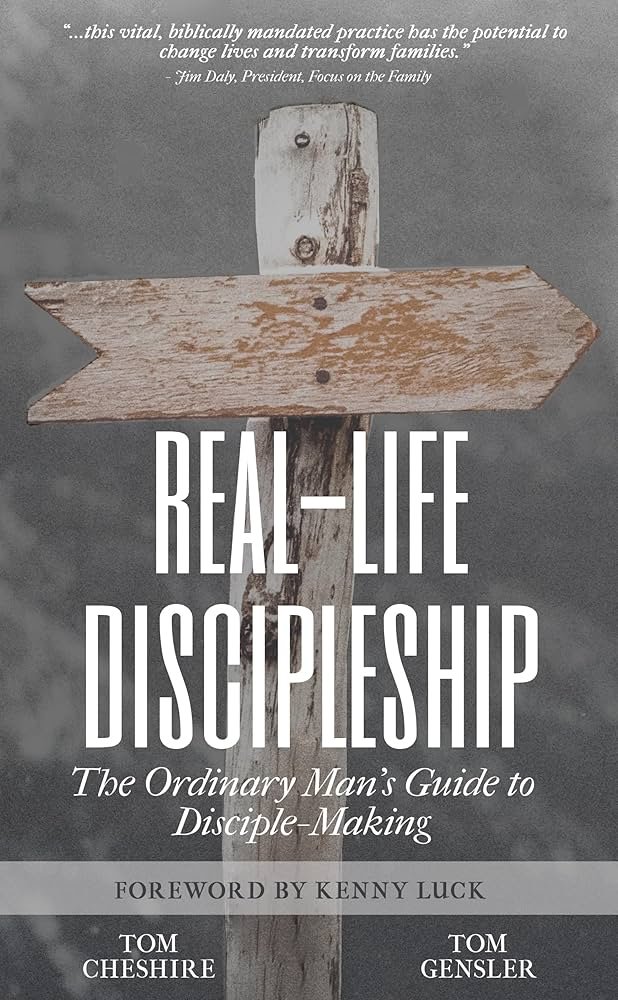
Real-Life Discipleship Book Review by Jeff Bush

By Tom Cheshire and Tom Gensler 

  • You can’t give away what you don’t possess.
  • If you were in a room of people and asked them about discipleship, almost everyone of them would refer to a person that helped them in their life.
  • Preaching is essential, but your preaching is not discipleship. 
  • Discipleship is 2 Timothy 2:2 in action.
  • Discipleship is the process of spiritual growth.
  • Jesus was not just telling disciples to be like Him, He was showing them how to live God-centered lives.
  • Discipleship is one individual investing in one or more other individuals on a consistent basis.
  • Which results more in your children listening — what you tell them to do or what they see you do? And this is what discipleship is about as well. 
  • You can and should be a disciple, as well as a disciple maker. 
  • You need to know who you are, but you also need to know Who’s you are. 
  • If you want others to follow your example, you must have been discipled and be discipling others.
  • Discipleship is not about perfection, but about progress.
  • Luke 6:12–13 teaches that before Jesus chose the disciples, He spent time in prayer.
  • Jesus always spoke to His Father. We would be wise to realize we cannot do anything on our own, we need God’s help. 
  • Discipleship is more caught than taught. Do not overcomplicate discipleship; recognize how Jesus walked and spent time investing in others.
  • Much of what you need to do with those you are discipling is to love them. 
  • In Luke 8, we see only 25% of the seed sown bears fruit. We should not be surprised that not everyone we disciple will bear fruit, but we still do our duty. 
  • The growth of an individual is not like a mushroom that shoots up quickly, rather like an oak that grows over a long period of time.
  • Discipleship is relational, it is life-on-life. 

People Can’t Drive You Crazy If You Don’t Give Them The Keys : Book Review by Jeff Bush

By Mike Bechtle 

  • Drama free doesn’t mean ridding of the drama, or the people that create it, rather the affect it has in you.
  • When it comes to drama, you have three choices: 
    1. Get the crazy person to change. 
    2. Live with the craziness. You can learn to accept it. 
    3. Get the crazy person out of your life. You can leave the situation.
  • Your relationship with God will help your relationship with others. 
  • When you determine to grow in spiritual maturity you’ll be able to better deal with drama and craziness.
  • We all have drama in our lives, but some people are controlled by it.
  • Our emotions are based on assumptions. The problem with assumptions is that we are basing solely on the facts that we have. 
  • Proverbs 18:17 teaches that our arguments make sense until we hear the other side.
  • False hopes destroy a relationship. While you’re expecting the other person to change, they likely are hoping for the same thing.
  • 5 truths about relationships:
          1. People with the most drama are the ones we spend the most time with (friends, family, coworkers, etc.). 
          2. Relationships take work.
          3. Relationships take time.
          4. The past doesn’t have to dictate the future.
          5. You don’t have to be the victim. 
  • When people are angry, they do not make logical decisions. 
  • The key to surviving crazy people is determining what we can and cannot control. We can control ourselves, but not others.
  • If each of us try to see how the other person sees, we’re laying the foundation for a good relationship.
  • If we want to best know how to use our car, we read the instruction manual. If we want to best know how to deal with other people, we read the instructions from the One who made people.
  • The key to managing our emotions is learning to manage our thoughts. 
  • Feelings come and go but love remains, and we are commanded to love. 
  • Realize that people are not accountable to you.
  • Reactive people focus on the problems while responsive people focus on the positive.