
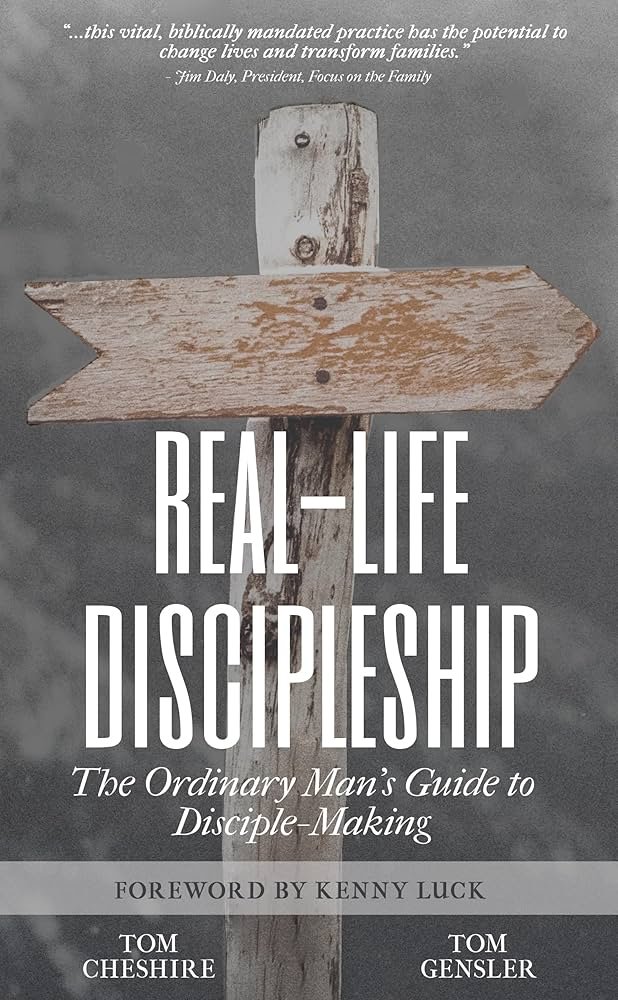
Real-Life Discipleship Book Review by Jeff Bush

By Tom Cheshire and Tom Gensler 

  • You can’t give away what you don’t possess.
  • If you were in a room of people and asked them about discipleship, almost everyone of them would refer to a person that helped them in their life.
  • Preaching is essential, but your preaching is not discipleship. 
  • Discipleship is 2 Timothy 2:2 in action.
  • Discipleship is the process of spiritual growth.
  • Jesus was not just telling disciples to be like Him, He was showing them how to live God-centered lives.
  • Discipleship is one individual investing in one or more other individuals on a consistent basis.
  • Which results more in your children listening — what you tell them to do or what they see you do? And this is what discipleship is about as well. 
  • You can and should be a disciple, as well as a disciple maker. 
  • You need to know who you are, but you also need to know Who’s you are. 
  • If you want others to follow your example, you must have been discipled and be discipling others.
  • Discipleship is not about perfection, but about progress.
  • Luke 6:12–13 teaches that before Jesus chose the disciples, He spent time in prayer.
  • Jesus always spoke to His Father. We would be wise to realize we cannot do anything on our own, we need God’s help. 
  • Discipleship is more caught than taught. Do not overcomplicate discipleship; recognize how Jesus walked and spent time investing in others.
  • Much of what you need to do with those you are discipling is to love them. 
  • In Luke 8, we see only 25% of the seed sown bears fruit. We should not be surprised that not everyone we disciple will bear fruit, but we still do our duty. 
  • The growth of an individual is not like a mushroom that shoots up quickly, rather like an oak that grows over a long period of time.
  • Discipleship is relational, it is life-on-life. 

Planting by Pastoring Book Review by Jeff Bush

By Nathan Knight 

  • Don’t look at the best business models, look to God. 
  • We love size and speed, but a church can grow and be healthy without those. 
  • Most authors and church planters say that size and speed are important in church planting, but when we go to Scripture, the narrative of God is more on slowness. Consider Abraham and Sarah who were childless for 25 years after being told they would have a child. Consider Israel who was is in slavery in Egypt for 420 years. Or consider the coming of Christ in which thousands of years have passed.
  • The essence of a church is not their financial stability.
  • Multiplication does not come at the expense of depth. 
  • Planting by pastoring is glorious and grace filled, but it is not efficient. It takes time and energy. 
  • Evangelism is not the finish line in church planting. 
  • We want to know names, not just see numbers. We want to know stories, not just statistics. 
  • We plant churches to pastor people individually so we can worship Jesus collectively.
  • What if Jesus did not intend for churches to look like McDonald’s serving a billion people, rather look like your kitchen to serve your family and friends?
  • Pastor’s sacrifice for their sheep
  • Jesus knew His people and His people knew Him. He pastored them as names and not numbers.
  • The foundation of the church is Jesus and His Gospel. If you are a church planter, you should ask yourself what lies at the foundation of this thing that you are spending so much time building. 
  • Let the size and significance of the church you are planting take care of themselves. Slow down and press the Gospel into the lives of the people just as Jesus did.
  • The people need to know that you are wanting to help them, not get something from them. You are a pastor, not an entrepreneur.
  • Jesus gathered men before He ever held a public campaign or evangelistic effort.
  • A planter pastor must have character, competence, and compassion. 
  • Charisma might attract people on the front end, but it rarely endures. Your love for Jesus will keep you there, not your charisma. 
  • The power is in the Gospel. A magnetic personality and eloquent composure is nice to have, but they are bonus, extra, and unnecessary. 
  • If you are planting churches to be respected, heard, and esteemed, you are doing so for the wrong reasons.
  • Plant churches for the identity of Jesus, not to find or focus on your own identity.
  • Our areas do not need community centers and places of entertainment, they need a church where Christ is preached.
  • If you’re going to plant a church you need to be sent out by a church. A church that will love you and lead you.
  • A church planting team will minimize weaknesses and maximize effectiveness. Throughout the Bible, we see teams going out. Paul and Barnabas, Jesus and the disciples, and even many letters that Paul signed included a team of people.
  • In planting a church, we can get so involved with a list of what needs done and neglect our own souls. 
  • A team helps you with encouragement and accountability.
  • Prayer is your lifeline to God. Prayer is essential.
  • You should allow people to challenge your thinking. Is the place you are wanting to go truly a place of need? 
  • When, choosing a city, ask yourself if you are reflecting the need of Romans 15:19–20.
  • Preach, pray, love, and stay in a community. 
  • Love people, not programs.
  • Use as many evangelistic tools as possible, but one of the best tools will be the church members’ influence on other people.
  • Church planters can rest in God’s fruit as they faithfully scatter the seed.