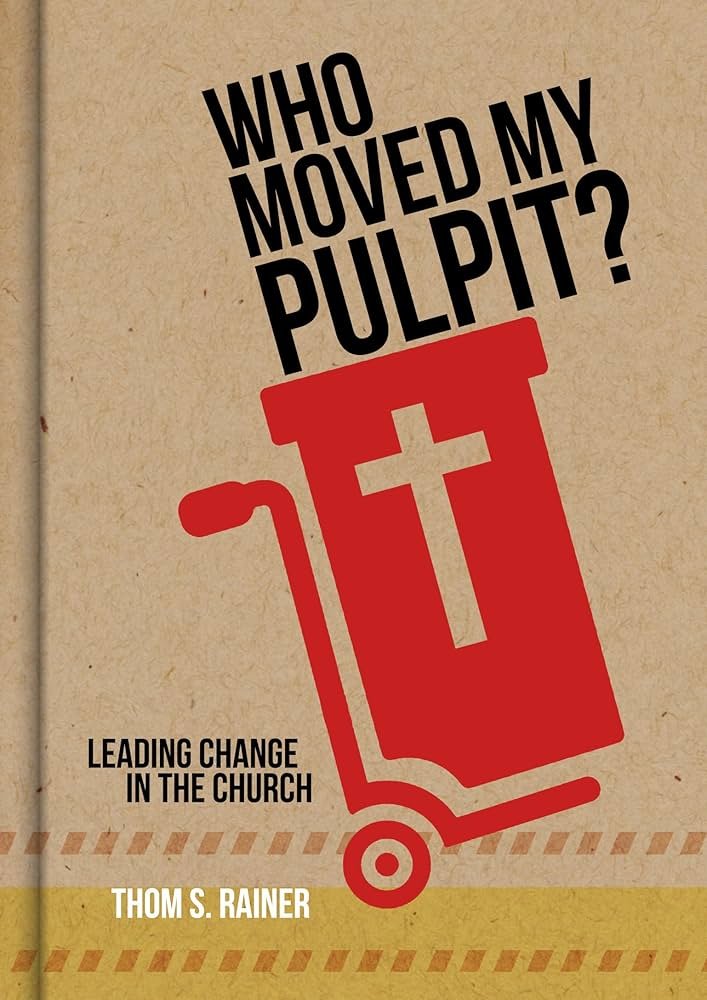
Who Moved My Pulpit Book Review by Jeff Bush

By Thom S. Rainer 

  • When leading to make a change, start it with prayer. Beginning in your own power, confidence and cockiness is a big mistake. 
  • When leading to make a change, you must asses unintended consequences. There will almost always be reactions beyond the change itself. 
  • When leading to make a change, make sure to always communicate. You cannot over-communicate!
  • When leading to make a change, deal with the people issues. Get buy-in from others, especially key people. 
  • When leading to make a change, model the right attitude in leadership. 
  • Five kinds of unmovable church members
        1. The Deniers. Some will just live in denial, but it is the fastest way to death. 
        2. The Entitled. Those who expect what they want. They don’t want anything that upsets their way of doing church.
        3. The Blamers. They would rather blame than take fault. They blame everything on culture, community and others. They resist change. 
        4. The Critics. They find fault in everything and everyone. 
        5. The Confused. Many times they are good innocent people, so they resist change. 
  • The following is a roadmap for leading change in your church: 
      1. Stop and Pray. 

Successful and sustaining change does not occur without prayer. 

Start with prayer. 

Ask for wisdom. 

You cannot see the future, but God can. 

Pray for courage. Pray for strength. 

      1. Confront and Communicate the Urgency for Change. 

Look at the statistics and face the reality. 

Get outside eyes and ask them to be blunt with you. 

Openly and honestly share the feedback and facts with your congregation. 

      1. Build an Eager Coalition. 

Find the influencers, get them on board and keep them in the loop. This will help to communicate to the rest of the group or congregation. 

      1. Become a Voice and Vision of Hope. 

Hope begins and continues with God. 

You lead in hope by reading the Bible daily, communicating that hope to others, and finding low hanging fruit to share with others. 

Hope has to accompany vision. 

      1. Deal with People Issues. 

Change is all about people. 

If you don’t deal with people issues, you will fail in the change. 

You have to love people more than you love change.

      1. Move From an Inward Focus to an Outward Focus. 

First, you must be an example of focus as a leader. 

You cannot lead in change without embodying change first. 

Outward focus begins with you.

      1. Pick low Hanging Fruit. 

What are some things you can do right now? 

Find, create and point out victories. 

      1. Implement and Consolidate Change. 

If you’re not careful, the change becomes more important than what you are going to do after the change. The means becomes the end. 

The number one reason for complacency is unclear and unstated vision. 

We do not change for change sake, but for the Gospel sake. 

We live in urgency because the gospel is urgent. 

  • There are always resistors, and many hesitant ones as well. What seems slow to you as a leader is likely too fast for those in the congregation. You need wisdom and discretion.
  • Leading in change begins in prayer, but you must continue in prayer as well. 
  • We do not want to change people, we want God to change people. 

To Fly Again: Book Review by Jeff Bush

By Gracia Burnham 

  • There are two things things that are for certain, that there will be trials and that he has overcome them John 16:33
  • Less than 1/4 of the world sleep in beds. The majority of the world are sleeping in hammocks, on the floor, on the dirt, or on something else.
  • When life spins out of control, we find out who we really are. 
  • What defines us is not what we have but who we are.
  • Anger doesn’t help. Anger in the face of trouble is common, but that does not make it productive.
  • Impatience is another way of saying I am important, what I want should happen, and it really doesn’t matter what anyone else needs. 
  • A fruit of the Spirit is patience. God‘s timing and God‘s way is always best.
  • Sometimes God calms the storm, and sometimes God calms you.
  • Our only hope is God‘s grace.
  • When we are weak, He can be strong. When we are shattered, He can put us back together again. When we are disputed, He can infuse us with His joy.

Thoughts for Young Men: Book Review by Jeff Bush

by J. C. Ryle

  • “Young men likewise exhort to be sober minded.” — Titus 2:6
  • Don’t wait until tomorrow. Tomorrow is the devil’s day. The devil wants you to put off tomorrow instead of living and serving God today.
  • “Rejoice, O young man, in thy youth; and let thy heart cheer thee in the days of thy youth, and walk in the ways of thine heart, and in the sight of thine eyes: but know thou, that for all these things God will bring thee into judgment.” — Ecclesiastes 11:9
  • Young man, do not deceive yourselves. Do not think you can fill yourselves of lust and simple pleasures now and then serve God when you are old.
  • If you do not seek the Lord while you are young, your sinful habits will be so entrenched that you will unlikely seek Him when you are old.
  • Some could say their sins are holding them back, others could say their idleness, but do not wait until later to serve the Lord.
  • Seek the Lord early, and you will be spared of many bitter tears.
  • There are dangers of young men face:
        1. Pride. 
                  • Pride is probably the oldest sin, and it sits in the heart of every man.
                  • Young men often think old men are dumb, and cannot help. Like wild horses, they must have their own ways. This is pride. 
                  • 1 Corinthians 8:2. Colossians 3:4, Romans 15:2. 1 Peter 5:5. 
                  • Never be afraid to sit and listen. Jesus did this in Luke 2:46. 
        1. Love of Pleasures.
                  • Col 3:25; 1 Cor 6:18
                  • Flee from the places that offer worldly pleasures. Flee from those who tempt you. Flee from talking about the worldly pleasures. Flee from the imaginations of thinking on them. 
        1. Contempt of Christianity.
                  • Beware of thinking you do not need to listen to preaching. Beware of mocking godly things. 
                  • Psalms 14:1
        1. Fear of Man’s Opinion.
                  • Proverbs 29:25
                  • What others call good, they call good. And what others call bad, they call bad.
                  • The fear of being ridiculed, mocked, or what others will think stops many young men.
                  • Learn to say no. Proverbs 1:10
        1. Not Considering Consequences of Sin.
                  • Proverbs 14:9
  • Your body is to be the servant of your soul, not your soul the servant of your body
  • Daniel sought God as a young man. So did Timothy, Josiah, David, and many others in the Bible.
  • Determine to make God’s Word your guide in life. 
  • Never make anyone a friend who is not a friend of God. Psalms 119:63; Proverbs 13:20
  • Devise to remove any sin that distances you from the Lord. The little sins separate you little by little until you are far from God. 
  • Resolve to never forget the eye of God. He knows you through and through. How many things are done because men think they are not seen, but He sees all. 
  • Resolve that wherever you are, you will pray. 

The Disciplines of the Christian Life: Book Review by Jeff Bush

By Eric Liddell

  • The secrets of growth are to develop a walk with God.

  • You will know as much of God as you are willing to put into practice. 
  • The bravest moment in a person’s life is when they look at themselves objectively without wincing. 
  • God asks you to surrender yourself to Him! 
  • Righteousness includes honesty in every area of life.
  • For a man to know his weaknesses is the first step in conquering them. 
  • Love is the secret of a happy home. 
  • The Bible says that we are stewards. God speaks of a wise steward, a foolish steward, a slothful steward, and faithful steward. 
  • You are a steward of your mind, possessions, body, money, and time. 
  • Fear comes from looking at self instead of looking at Jesus.
  • The church needs your worship, your witness, and your work. 

Suffering is Never for Nothing: Book Review by Jeff Bush

By Elisabeth Elliott 

  • It is through the deepest sufferings that God teaches us the deepest lessons. 
  • We can come through anything knowing that God is in charge, He has a loving purpose, and He can transform something terrible into something wonderful.
  • A simple definition for suffering could be: having what you don’t want or wanting what you don’t have. 
  • We wonder if God is paying attention, and the answer is yes. He does love us and He is doing something and He will do something.
  • From the worst thing in the world (the cross) comes the greatest thing in the world (salvation).
  • Joy is not the absence of suffering, but the presence of God.
  • When Job asks God questions during his suffering, God never does seem to answer the questions. God replies back with more questions for Job.
  • Faith is not a feeling, it is a wield action of obedience.
  • Two things that should distinguish a Cristian are acceptance and gratitude.
  • Make it a habit of saying thank you Lord instead of complaining. 
  • You can thank God in advance because you know that no matter what happens, God is still in charge.
  • Gratitude honors God.
  • Gratitude prepares the way for God. 
  • If my life is broken for Jesus, it might mean that He wants to use it to feed the multitudes.
  • Suffering will cause us to long for that better country.
  • Colossians 1:24 and Philippians 1:29 speak about the joy of suffering.
  • The best fruit comes after the pruning. The best gold comes from the refining fire. Joy comes out of sorrow, and life comes out of death.

Seasons of Sorrow Book Review by Jeff Bush

By Tim Challies 

  • When a child of God dies, he does not go away, rather goes ahead. 
  • The Bible uses the example of sleep for death. Sleep is a time to rest, but it is not an end. 
  • God is good all the time. There’s no laps in God’s sovereignty. 
  • Who are we to deem something as evil if God has deemed it as good. 
  • Bless God in the giving and in the taking. 
  • Our children are more God’s creation than our procreation. 
  • Be careful to distinguish the purpose from the results – why God did something and how God will use it.
  • You can accept something by faith as God‘s will, and God‘s will is always perfect. 
  • Do not charge God with wrong. 
  • You can receive something as a trial to steward instead of a punishment to endure.
  • Things may scar you but they do not have to define you. 
  • God was, is, and will be with you at all times. 
  • We can decide to bow our will to God’s throne.
  • God’s actions are always good and His timing is always perfect.
  • God gave talents: to one servant, one; to another, two; and to another, five. He never asked who wanted what/how many talents, and He doesn’t ask us what He will give or take from us. 
  • A perfect God with with perfect character will display His perfect Will. 
  • God begins every life, has authority over every life, and ultimately ends every life. 
  • Death is the great interruptor. It is also the great redirector. 
  • You do not have to spend the rest of your life incapacitated by sorrow, you can allow it to motivate you to serve God greater. 
  • God owes you no answer, and you would be wrong to demand one. 

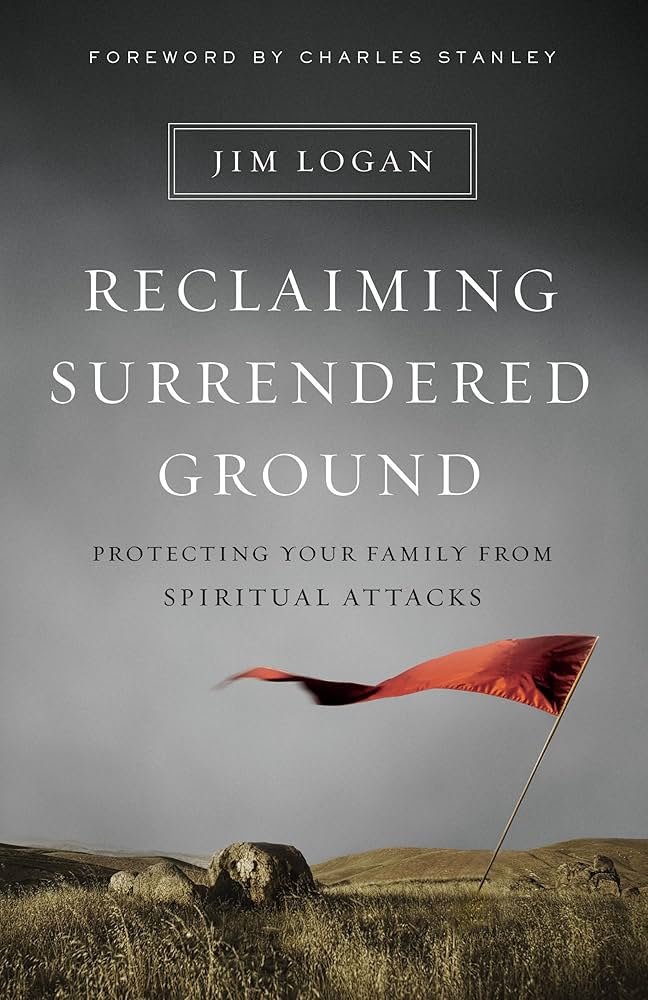
Reclaiming Surrendered Ground: Book Review by Jeff Bush

By Jim Logan

  • The devil has no authority in the Christian’s life, accept for that which has been surrendered to him.
  • If it is possible to give ground or place to the devil, as Ephesians 4:27 says, then it is also possible to reclaim that ground.
  • The devil wants to kill, steal, and destroy. The good news for us is that he is a defeated foe. 
  • We do not need to ask others if they have the victory, we need to ask if they are standing in the victory they already have. 
  • Since every Christian faces spiritual warfare, every Christian is also equipped with the spiritual tools needed for the war. 
  • If the Christian could not be influenced by the devil, then why are we told to put on the armor of God and stand firm (Ephesians 6:10), to take every thought captive (2 Corinthians 10:5), and to resist the devil (James 4:7)?
  • The popular word that the world uses is “addiction,” but God uses the word “sin.” Addiction gives the idea that you’re a victim of something, but sin suggests you’re making a choice.
  • When you give ground to the devil, he can begins digging a foundation to construct whatever he wants.
  • When Lazarus was raised from the dead, he had life but was bound with grave clothes and needed help being unwound. 
  • Fathers, you have great responsibilities, and the devil wants to attack you, but you have great resources in God.
  • As a child of God, you’re calling is to get to know your Father, not the enemy. You should be aware of the devil, but not fear him because you are God’s child.
  • Getting free can be easy, but staying free is the challenge.
  • You are not fighting to gain victory, you’re fighting from a position of victory. The devil is a defeated foe!
  • We have been delivered from the power of darkness, but not from the presence of darkness. We still live in a wicked world.
  • Because Satan is already defeated, his only power is in deception.

Pleasing People Book Review by Jeff Bush

By Lou Priolo 

  • The sin of pride is at the heart of people pleasing.
  • Codependency (best term used in society for people pleasers) probably best falls under the category of idolatry. It is loving the approval of men more than the approval of God.
  • There are two sides to idolatry; the first side is neglecting God, and the second side is replacing God with a cheap substitute.
  • Fearing God will keep us from sin, but fearing man will bring a snare (Proverbs 29:15; John 12:42–43).
  • People pleasing is not keeping the peace, rather abandoning the peace of God for peace with man. It is being a coward at heart.
  • People pleasers rarely confront or speak to others about the sin in their lives.
  • The people pleaser is unsatisfied with his own life, coveting what God has given to others.
  • Man pleasing causes one to have many masters.
  • People pleasing places one under bondage because they’re attempting to please man more than please God.
  • Trying to please man will cause you to lose rewards — Matthew 6:1-6, 16-18
  • The inordinate desire to please men will blind you from sin — Matthew 23:16-26
  • Pride tempts you to change things in your life according to man’s priorities instead of the Holy Spirit’s agenda.
  • Pride focuses on changing the outward more than the inward.
  • Excessive love of what other think causes you to believe opinion of self over God’s opinion — John 5:44
  • People pleasing can cause to listen more to flattery of man than conscience and Spirit. Look into the mirror of God’s Word more than approval of man.
  • It’s not wrong wanting to please others as long as it doesn’t cause you to say no to the approval of God
  • People pleasing cause one to be indecisive.
  • People pleasing causes one to be a hypocrite.
  • The people pleaser depends more on his abilities to get friends than he depends on God to give him friends.
  • If pleasing God does not satisfy you, no amount of men’s approval will satisfy you.
  • If you want to stop being a men pleaser, work at being a God pleaser. You must have a stronger desire to please God.
  • The God pleaser is more concerned with what God sees on the inside, rather than what man sees on the outside.
  • A God pleaser programs his life by God’s Word instead of the world’s culture.
  • Ephesians 5:8–10 commands us to know how to please God. 
  • It is not wrong please others, but it is wrong to love the pleasure of man to the point it places you in bondage.
  • Instead of asking what would please others, ask yourself what would please God.